
Smart thermostat OEM vs ODM: what changes?
author
Choosing a smart thermostat OEM or ODM partner changes much more than the logo on the device. For procurement teams, operators, and business evaluators in renewable energy and smart building projects, the real differences show up in customization depth, protocol support, certification ownership, firmware control, data visibility, supply chain risk, and long-term maintenance costs. In practice, OEM is usually the faster and lower-risk route when you need a proven product with limited changes, while ODM is the better fit when you need product differentiation, tighter ecosystem alignment, or a thermostat designed around specific HVAC automation and energy management goals.
If your team is comparing suppliers, the key question is not simply “OEM or ODM?” It is “What exactly needs to change in the product, who controls those changes, and what risks come with that control?”
What actually changes between smart thermostat OEM and ODM?
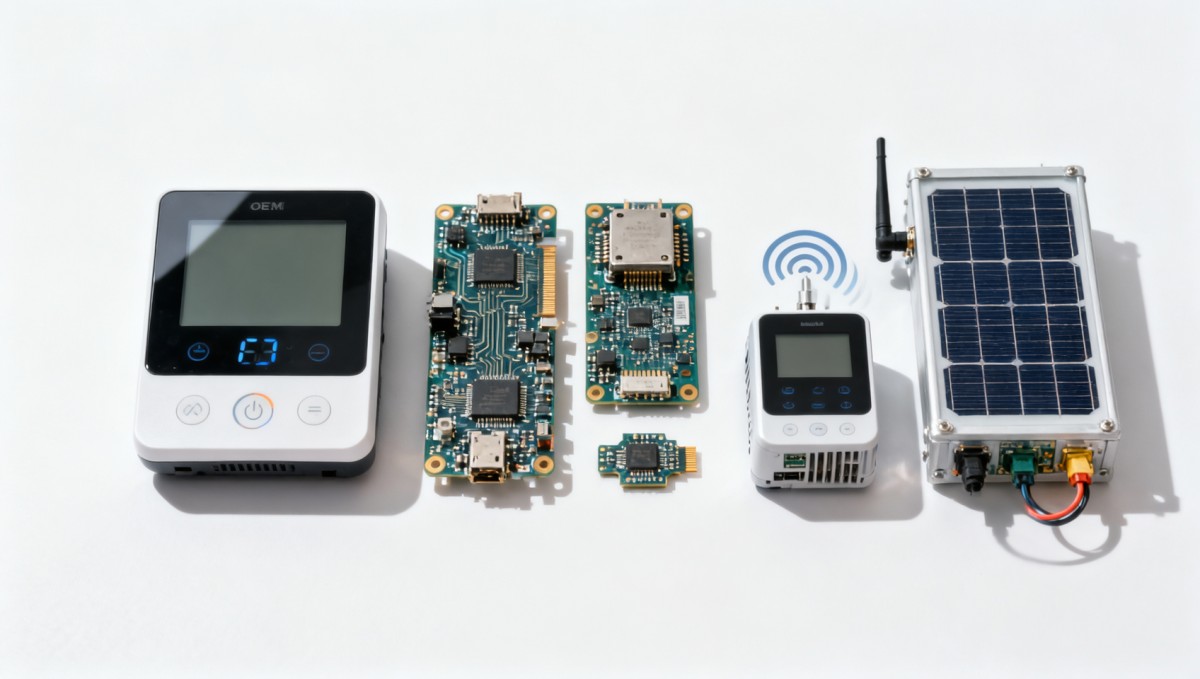
At a high level, OEM and ODM differ in who owns the product concept, who controls the technical roadmap, and how much freedom the buyer has to modify the device.
With OEM smart thermostat sourcing, the factory already has an existing thermostat platform. The buyer typically applies its own branding and may request limited adjustments such as enclosure color, packaging, app branding, language options, or minor firmware settings. The hardware architecture, communication module choices, PCB layout, and core control logic usually remain close to the factory’s standard design.
With ODM smart thermostat development, the manufacturer designs or significantly adapts the thermostat based on the buyer’s requirements. That can include changes to the industrial design, UI flow, sensor stack, HVAC control logic, energy reporting functions, protocol combinations, gateway dependencies, and cloud or app integration. ODM gives more flexibility, but it also introduces more engineering validation, more decision points, and more responsibility for specification accuracy.
For smart buildings and renewable energy projects, this distinction matters because thermostat behavior affects not only room comfort but also demand response, peak-load optimization, heat pump compatibility, occupancy scheduling, and interoperability with broader IoT systems.
For buyers and evaluators, the biggest difference is control versus speed
Most commercial buyers care about a practical tradeoff: how much control they need versus how quickly they need to launch.
OEM is usually better when:
- You need a product to market quickly
- You want lower upfront engineering cost
- You can accept a proven reference design
- You mainly need branding, packaging, and light software changes
- You prefer lower technical complexity in supplier management
ODM is usually better when:
- You need meaningful product differentiation
- You must support a specific HVAC or building automation scenario
- You require custom firmware behavior or deeper protocol adaptation
- You want tighter integration with your own app, EMS, or smart energy platform
- You need strategic ownership over feature direction and roadmap
In other words, OEM buys speed and predictability. ODM buys flexibility and product fit. Neither is automatically better. The right choice depends on whether your commercial value comes from faster sourcing or from a thermostat that is better aligned with your ecosystem.
What changes in customization scope?
Customization is where many sourcing discussions become unclear. Suppliers may claim “custom support” for both OEM and ODM, but the depth of change is very different.
Typical OEM customization includes:
- Brand logo and visual identity
- Retail or project packaging
- User manual localization
- Basic mobile app branding
- Minor interface changes
- Preset operating parameters
Typical ODM customization may include:
- New industrial design or mounting structure
- Different display type or touch interface
- Custom temperature and humidity sensor configuration
- Support for different HVAC system types
- Matter, Zigbee, Thread, Wi-Fi, or BLE architecture decisions
- Custom cloud API integration
- Energy-saving algorithms or occupancy-based control logic
- Regional compliance adaptation
For procurement and business assessment teams, the key is to document the change request in measurable terms. “Need a custom thermostat” is too vague. A useful requirement looks more like this: support multi-stage heat pump systems, expose energy consumption data to a local gateway, maintain stable Matter commissioning in dense apartment deployments, and allow white-labeled app provisioning.
The more precise the requirement, the easier it becomes to determine whether OEM is enough or ODM is necessary.
What changes in protocol compatibility and smart ecosystem integration?
In the smart thermostat category, protocol support is often the most underestimated difference between OEM and ODM. Many buyers assume that if a supplier offers Zigbee, Wi-Fi, Thread, or Matter, the integration challenge is solved. In reality, protocol labels alone do not guarantee deployment success.
With an OEM model, protocol behavior is usually inherited from an existing platform. That can be an advantage if the platform has already been tested in real-world environments. But it can also be a limitation if you need a specific commissioning flow, gateway interaction, cluster behavior, or interoperability profile that the standard product does not support.
With ODM, you may be able to shape protocol implementation around the project. For example:
- Adjusting Matter feature sets for smart home platform compatibility
- Optimizing Thread behavior in dense multi-unit buildings
- Aligning Zigbee thermostat clusters with existing control infrastructure
- Supporting local control for privacy or latency-sensitive energy applications
- Integrating with demand response or renewable energy management systems
This is especially important in renewable energy use cases where the thermostat is not just a comfort device. It may need to work as part of a broader load-shifting strategy, coordinate with solar production patterns, or respond to utility-driven pricing events. In these cases, ODM often provides better alignment with project objectives, but only if the manufacturer has genuine protocol engineering capability rather than marketing-level compatibility claims.
What changes in compliance, certification, and responsibility?
Compliance is one of the most important practical differences between OEM and ODM, especially for cross-border sourcing and large-scale property deployment.
In an OEM arrangement, the factory often already holds part of the necessary certification set for the base model. That may include electrical safety, EMC, radio approvals, or selected smart home ecosystem certifications. This can reduce launch time, but buyers should verify exactly what is covered and whether any modification invalidates the existing test basis.
In an ODM project, certifications may need to be updated, expanded, or re-run depending on how much the product changes. That affects cost, schedule, and risk. It also raises critical questions:
- Who owns the certification reports?
- Who pays for re-testing?
- Who is responsible if protocol compliance fails after firmware updates?
- Can the buyer use the same reports in multiple target markets?
- Will regulatory changes require redesign?
For business evaluators, this is where supplier selection should move beyond brochure comparisons. Ask for evidence of protocol compliance, environmental reliability testing, firmware version control, and audit-ready documentation. In a smart thermostat project, especially one connected to HVAC automation controllers and energy systems, compliance is not a one-time checkbox. It is part of lifecycle risk management.
What changes in performance data and technical validation?
One of the biggest sourcing mistakes is evaluating OEM versus ODM as a commercial model only. In reality, the better choice often becomes obvious when you review the data.
Buyers should request measurable validation in areas such as:
- Temperature sensing accuracy and drift over time
- Humidity sensing performance
- Relay endurance and switching stability
- Standby power consumption
- Wireless latency and packet reliability
- Commissioning success rate
- App-to-device response time
- Behavior under unstable power or network interference
- HVAC control stability under real load conditions
An OEM platform may show stronger reliability data because it has already been deployed and refined. An ODM design may better fit the intended use case, but only after more testing cycles. That is why technical benchmarking matters. If your thermostat is expected to contribute to carbon reduction, demand response, or efficient heat pump control, then performance claims should be supported by verifiable test results, not generic terms like “smart,” “efficient,” or “works with major platforms.”
What changes in cost structure and sourcing risk?
OEM and ODM differ not only in product design but in financial structure.
OEM typically has:
- Lower non-recurring engineering cost
- Shorter development cycle
- Lower specification risk
- Faster sample availability
- Potentially lower minimum order barriers for standard models
ODM typically has:
- Higher upfront development and tooling cost
- Longer validation timeline
- More project management complexity
- Greater dependence on specification quality
- Better opportunity for long-term product differentiation
However, a lower initial price does not always mean lower total cost. A cheap OEM thermostat can become expensive if it lacks protocol stability, causes support issues, fails integration testing, or cannot evolve with your platform strategy. Likewise, an ODM project can become wasteful if the customization adds complexity without meaningful market or operational benefit.
For procurement teams, the right comparison is total lifecycle cost: acquisition, certification, integration effort, maintenance, warranty exposure, and upgrade flexibility.
How should you choose between OEM and ODM for a smart thermostat project?
A simple decision framework can help.
Choose OEM if:
- Your brand value does not depend on unique hardware behavior
- You need reliable deployment in a short time frame
- Your target markets accept standard feature sets
- You want a lower-risk sourcing path
- The supplier can prove stable performance and compliance on the existing model
Choose ODM if:
- Your thermostat must fit a specific smart energy or building automation strategy
- You need deeper integration with your own ecosystem
- Standard market models do not support your HVAC requirements
- You need more control over firmware, UI, data, or protocol behavior
- You are building a differentiated product line rather than reselling a standard unit
Before making the final decision, ask suppliers these practical questions:
- Which parts of the product can actually be changed?
- What test data supports current performance claims?
- Who owns firmware source control and update rights?
- What certifications already exist, and what must be repeated?
- How does the device perform in high-density smart building environments?
- What happens if a protocol standard evolves after launch?
- Can the supplier support long-term component continuity?
Final takeaway: the real difference is who controls the product outcome
Smart thermostat OEM vs ODM is not just a manufacturing label comparison. It is a decision about control, risk, speed, and long-term product fit. OEM is generally the practical choice when you need a tested product, faster commercialization, and manageable sourcing complexity. ODM becomes the stronger option when your business depends on custom HVAC logic, ecosystem integration, energy management alignment, or product differentiation.
For users, operators, procurement teams, and business evaluators, the most useful approach is to focus on what truly changes: customization depth, protocol behavior, compliance responsibility, technical validation, and lifecycle cost. If a supplier cannot explain those changes clearly with evidence, the sourcing risk is already higher than it should be.
In a market shaped by connected buildings, carbon reduction goals, and increasingly complex IoT standards, the right smart thermostat partner is not the one with the broadest claims. It is the one whose product model, engineering data, and supply chain transparency match your real deployment needs.
Protocol_Architect
Dr. Thorne is a leading architect in IoT mesh protocols with 15+ years at NexusHome Intelligence. His research specializes in high-availability systems and sub-GHz propagation modeling.
Related Recommendations
- Kenji Sato (Infrastructure Arch)VDE Launches Matter-over-Thread Gateway Energy Efficiency Standard
- Kenji Sato (Infrastructure Arch)Climate control hardware benchmarking made practical
- Kenji Sato (Infrastructure Arch)Smart thermostat OEM vs ODM: what changes?
- Kenji Sato (Infrastructure Arch)How to choose HVAC automation controllers that last
- Kenji Sato (Infrastructure Arch)How HVAC PID Control Improves Comfort
- Kenji Sato (Infrastructure Arch)Thermostat Temperature Hysteresis: Best Settings
- Kenji Sato (Infrastructure Arch)How to Find a Reliable HVAC Relay Supplier
- Kenji Sato (Infrastructure Arch)Smart Thermostat OEM: Key Factory Questions
- Kenji Sato (Infrastructure Arch)Hangzhou Refrigeration & Cold Chain Expo 2026 Sets Green & Smart Standards for Global Buyers
- Kenji Sato (Infrastructure Arch)Cloud Cellar Launches Fine Wine Division, Boosts Smart Supply Chain Demand
Analyst