
Vietnam Tightens Import Rules for Vision AI Devices
author
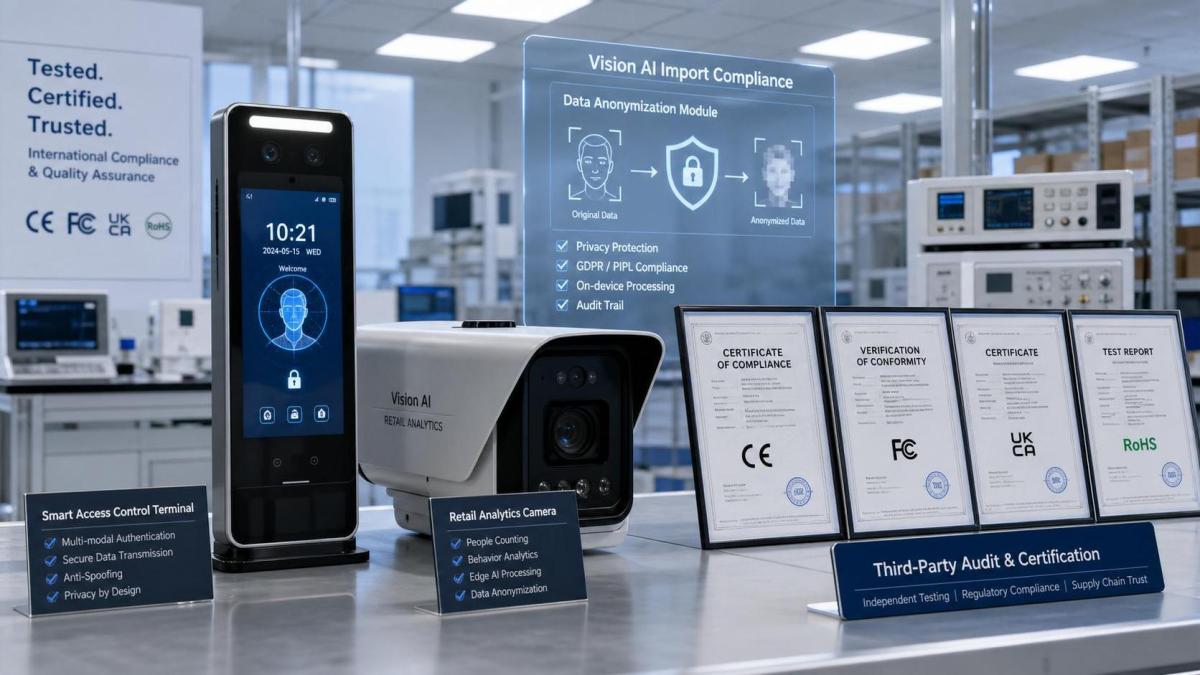
On July 4, 2026, Vietnam’s Ministry of Information and Communications (MIC) signed Circular 18/2026/TT-BTTTT, introducing a new import compliance requirement for devices with Vision AI functions. From August 2026, imported products such as smart access control systems and retail analytics cameras must include a locally operating data anonymization module certified by the National Cybersecurity Center of Vietnam (NCIS) and be accompanied by a third-party audit report. This matters not only for importers, but also for manufacturers, procurement teams, compliance managers, testing partners, and delivery planners because the rule directly affects market entry conditions, documentation readiness, and lead times.
What the new requirement clearly changes
The confirmed change is regulatory and product-specific. According to the information provided, Vietnam has set a condition for the import of all devices that contain Vision AI functionality. The requirement covers imported equipment including examples such as smart access control devices and retail analytics cameras.
The rule requires two elements: first, an on-device local data anonymization module that has been certified by NCIS; second, a third-party audit report. The measure applies to all importers. The only stated exemption is for government cooperation projects. The transition period is 30 days, and the rule is set to apply from August 2026.
Where the pressure is likely to appear across the chain
For importers, compliance becomes part of customs readiness
From an industry perspective, importers are likely to feel the immediate effect because the rule turns product compliance into an entry prerequisite. The practical impact may appear in pre-shipment document preparation, product qualification checks, and coordination with suppliers on whether the required anonymization module and audit materials are ready before goods are dispatched.
What deserves closer attention is whether internal import workflows, technical files, and supplier declarations are sufficient to support the new requirement. Even without additional execution details in the input, the need to present compliant product status is already clear.
For manufacturers, product design and certification timing become commercial issues
Manufacturers supplying Vision AI terminals to Vietnam may be affected at the product configuration level. If a device currently does not include a local anonymization module certified by NCIS, the issue is not only technical but also commercial, because it can affect whether the product remains importable within the new timeline.
Analysis shows that design validation, certification scheduling, and third-party audit preparation may become part of quotation, model selection, and delivery discussions. Products sold across multiple markets may also require market-specific compliance handling if the Vietnam-bound version needs additional localized features or documentation.
For buyers and channel partners, procurement and delivery assumptions may need revision
Procurement teams, distributors, and channel partners may need to review whether current purchase plans still align with the new rule. The information provided already indicates that compliance costs and delivery cycles for Vision AI products entering Southeast Asia will rise, which means sourcing assumptions based on previous lead times may no longer hold.
In practical terms, this may affect bid preparation, order timing, model approval, and inventory planning. Buyers may need to confirm earlier in the procurement cycle whether the imported device version is intended for the Vietnam market and whether the supporting audit report is available.
For testing and service partners, documentation quality will matter more
Testing bodies, audit support providers, and after-sales service teams may also be drawn into the compliance chain. The rule explicitly refers to a third-party audit report, which means technical evidence and product records are likely to carry more weight in market access preparation.
Observably, service teams may also need to understand how compliant product versions are identified and supported after delivery, especially where product replacement, maintenance, or model substitution could trigger documentation questions.
Operational points companies should watch now
Check whether affected product lines fall within the Vision AI scope
Companies should first identify which imported devices include Vision AI functionality and therefore may fall under the new rule. This is especially relevant for products whose AI features are embedded in security, retail, or access control equipment rather than sold as standalone AI systems.
Review certification and audit dependencies before shipment commitments
Analysis shows that shipment scheduling can no longer be separated from compliance readiness. Businesses should pay close attention to whether the required NCIS-certified local anonymization module has already been incorporated into the product and whether the third-party audit report can be prepared in time for import use.
Recheck contract files, tender materials, and technical documentation
Where products are sold through projects, channel agreements, or formal procurement processes, technical specifications and supporting documents may need closer review. What deserves closer attention is whether sales files, bid documents, and model descriptions clearly reflect the compliant product configuration intended for Vietnam.
Plan for shorter transition timing and possible delivery friction
The 30-day transition period is short relative to typical hardware compliance and cross-border delivery cycles. It is more appropriate to understand this as an immediate operational signal rather than a distant policy topic. Companies should therefore watch for friction points in order confirmation, supplier qualification, audit scheduling, and import document completion.
Why this looks like an execution signal, not only a policy headline
Observably, this development is more than a general statement about AI governance. The combination of a named circular, a defined product requirement, a certification condition, an audit requirement, and a short transition period gives the change the character of an actionable market-entry rule.
At the same time, analysis should remain disciplined. The input does not provide detailed enforcement procedures, detailed certification workflows, or customs handling instructions. For that reason, it is more appropriate to understand the news as a clear compliance signal with operational consequences, while still recognizing that execution details and market practice will need further verification.
How the market is likely to read this change
From an industry perspective, the significance of this measure lies in how it shifts Vision AI imports from a product performance discussion toward a compliance architecture discussion. The requirement for a locally certified anonymization module and a third-party audit report suggests that product eligibility, documentation completeness, and delivery planning will matter more in transactions tied to Vietnam.
A balanced reading is that the rule already represents a concrete change in import conditions, but its full commercial effect will depend on how certification practice, procurement documents, and importer implementation develop after the effective date. For now, it is best understood as a live compliance development that companies should prepare for rather than merely monitor from a distance.
Basis of this article and what still needs verification
This article is based on the user-provided news title, event date, and event summary. For developments of this kind, relevant source types typically include official government notices, regulator publications, customs or trade authority updates, industry association releases, standards-related documents, and reporting by established industry media.
No specific official source link was provided in the input, so the underlying official publication path still needs to be verified on an ongoing basis. Further observation should focus on implementation details, certification interpretation, audit expectations, changes in tender documents, market feedback, and how companies actually adjust product configuration and delivery arrangements after the rule takes effect.
Protocol_Architect
Dr. Thorne is a leading architect in IoT mesh protocols with 15+ years at NexusHome Intelligence. His research specializes in high-availability systems and sub-GHz propagation modeling.
Related Recommendations
- Lina Zhao(Security Analyst)How to Design a Smart Building Security Ecosystem That Integrates Access, Video, and Energy Data
- Lina Zhao(Security Analyst)How Lidar-Camera Fusion Improves Autonomous Inspection Robots for Solar Farms
- Lina Zhao(Security Analyst)How to Choose AI Security Cameras for Apartments Without Compromising Privacy
- Lina Zhao(Security Analyst)How to Evaluate a Commercial AI Camera Supplier for Long-Term Project Reliability
- Lina Zhao(Security Analyst)How to Plan Smart Security for Warehouses: Access Control, AI Monitoring, and ROI
- Lina Zhao(Security Analyst)How to Choose a Smart Traffic Sensor for Intersections: Key Specs and Deployment Factors
- Lina Zhao(Security Analyst)How to Evaluate Custom AMR AGV Navigation for Complex Warehouse Routes
- Lina Zhao(Security Analyst)METI Tightens Audit Rules for Vision AI Security Devices
- Lina Zhao(Security Analyst)Smart Camera Infrared Range Explained: What Affects Night Detection Distance?
- Lina Zhao(Security Analyst)Vision AI for Renewable Energy: 7 Inspection Tasks It Can Automate
Analyst