
How to choose a vision camera for PCB inspection defects
author
Choosing the right vision camera for PCB inspection can make or break defect detection accuracy, production yield, and long-term reliability in renewable energy and IoT hardware. This guide explains how to evaluate vision camera for PCB inspection systems through real engineering metrics—covering machine vision for defect detection, machine vision lens distortion test, sensor fusion lidar and camera, and edge AI for smart manufacturing—so operators, buyers, and decision-makers can move beyond marketing claims and choose with confidence.
Why PCB inspection cameras matter more in renewable energy electronics
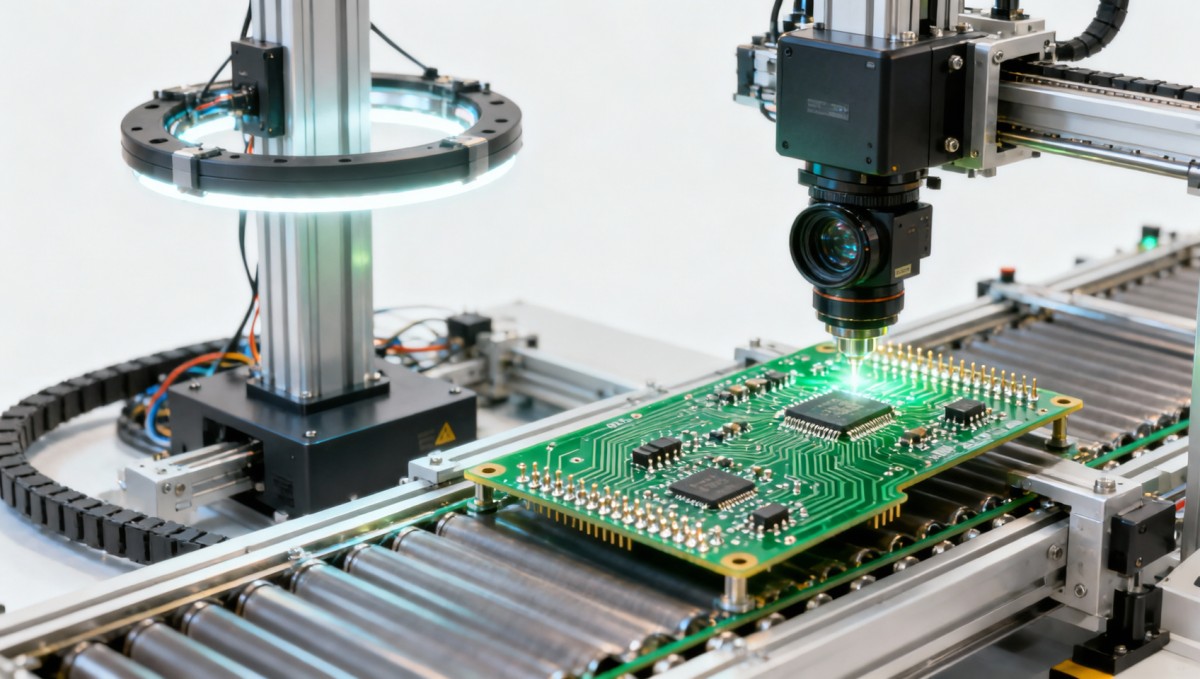
In renewable energy manufacturing, PCB defects are not just cosmetic issues. A solder bridge inside a battery management system, an offset component on a solar inverter control board, or a trace anomaly in a smart metering node can cause unstable communication, thermal drift, field failure, or inaccurate energy data. That is why a vision camera for PCB inspection must be evaluated as a risk-control device, not as a generic imaging accessory.
For information researchers and procurement teams, the challenge is that many suppliers describe image quality in vague terms while skipping measurable criteria such as pixel resolution at working distance, exposure stability, distortion rate, and repeatability across 8-hour to 24-hour production shifts. In electronics used for solar storage, EV charging, microgrids, and smart building energy controls, these details directly affect outgoing quality and warranty exposure.
Operators care about something different. They need stable imaging under changing board colors, reflective solder joints, and mixed component heights. A system that performs well in a demo may fail when production changes from small communication boards to denser power-control PCBs. A practical selection process should therefore focus on at least 4 dimensions: defect capture capability, mechanical compatibility, software integration, and long-run maintenance burden.
This is where NHI’s data-driven philosophy becomes useful. In fragmented IoT and smart energy supply chains, marketing language often hides the real engineering bottleneck. A camera advertised as high speed or high precision is not enough. Buyers need benchmark logic tied to board size ranges, lighting conditions, protocol compatibility, and edge AI deployment options that can survive real factory conditions.
What defects should the camera reliably detect?
The required camera specification depends on the defect class. In renewable energy electronics, common inspection targets often include missing components, tombstoning, polarity errors, solder bridges, insufficient solder, lifted leads, pad contamination, connector misalignment, silkscreen mismatch, and QR or traceability code reading. A single camera setup rarely optimizes all of them equally.
- For fine-pitch SMT defects, buyers usually prioritize pixel density, focus consistency, and low distortion across the field of view.
- For power boards with tall capacitors, transformers, or heat sinks, depth variation and shadow control become critical.
- For mixed-use boards in energy gateways or smart relays, reading markings and checking component presence may need different lighting and algorithm settings.
A good starting point is to group defects into 3 inspection families: geometric defects, surface-quality defects, and identity defects. This classification helps avoid overpaying for features that do not improve real defect escape rates.
How to choose the right vision camera for PCB inspection by technical metrics
When selecting a vision camera for PCB inspection, start with imaging physics rather than brochure terminology. Resolution alone is not enough. A 12 MP camera may underperform a lower-megapixel model if the lens is mismatched, lighting is unstable, or the working distance creates insufficient effective pixels on the target defect. For most inline PCB applications, the better question is whether the system can resolve the smallest defect of interest with repeatable contrast.
A practical engineering rule is to define the smallest critical feature first, then calculate field of view, sensor size, lens magnification, and exposure margin. If your inspection target includes fine solder issues on pads or leads, the system should maintain usable detail across the entire inspection area, not only at the center. This is exactly why a machine vision lens distortion test matters during evaluation.
For renewable energy PCBs, another key variable is board diversity. Production lines may process compact sensor nodes in one shift and larger inverter control boards in the next. That means the camera and lens should support a stable setup across multiple board dimensions, or the line will lose time to recalibration every 2–4 weeks when product mix changes or fixtures are updated.
The table below summarizes the main technical criteria that buyers, process engineers, and decision-makers should review before approving a machine vision system.
The main lesson is simple: a vision camera for PCB inspection should be judged by system-level fit. Sensor, lens, lighting, trigger, and algorithm all influence defect capture. If one part is weak, the line pays through false rejects, missed defects, or operator intervention.
Core parameter checks before sample approval
Before issuing a purchase order, request a sample evaluation with at least 3 board types, 2 lighting conditions, and 1 known defect set. This is more useful than relying on a single showroom demonstration. The sample run should include reflective areas, dark solder mask zones, and components of different heights.
Recommended checklist
- Confirm the minimum detectable feature size under real working distance, not only lab distance.
- Verify distortion and sharpness at the outer 10%–15% of the field of view.
- Check whether exposure remains stable during continuous operation over one full production shift.
- Review integration effort for PLC, MES, and defect image storage.
These 4 checks often reveal whether a supplier understands production engineering or is only selling components.
Which camera architecture fits your line: 2D, 3D, or sensor fusion?
Not every PCB line needs the same machine vision architecture. Standard 2D cameras remain effective for many presence, polarity, marking, and solder-shape tasks. However, renewable energy boards frequently include connectors, power modules, shielding, and height variation that reduce the reliability of pure 2D inspection. In those cases, 3D imaging or sensor fusion lidar and camera approaches can improve robustness.
Sensor fusion is especially relevant when the line must inspect mechanical position and visual quality in one pass. For example, on boards used in energy storage controllers, the system may need to verify coplanarity, pin seating, and surface defect appearance together. Combining camera data with depth information can reduce blind spots caused by shadowing or reflective metal surfaces.
Still, more technology does not always mean better procurement. A more complex architecture raises cost, integration effort, and maintenance requirements. Buyers should compare total inspection value over a 12–36 month period, including calibration time, false reject impact, spare parts, software licensing, and retraining needs for operators.
The comparison below helps align architecture choice with defect risk, board complexity, and smart manufacturing goals.
If your line primarily handles stable PCB formats and standard SMT defects, a well-configured 2D system may be the best value. If your boards contain more mechanical variation or higher warranty risk, adding 3D or sensor fusion can be justified. The right answer depends on defect economics, not novelty.
How edge AI changes inspection decisions
Edge AI for smart manufacturing is becoming more relevant because many factories want faster local decisions, lower latency, and less dependency on remote processing. On a PCB line, edge AI can support anomaly classification, defect image triage, and adaptive thresholding without sending every image to a central server.
This matters in renewable energy supply chains where traceability and response speed are critical. If a defect cluster appears on a battery control board, local analytics can flag the issue within minutes instead of waiting for delayed review. But edge AI only adds value if the camera output is consistent. Weak optics cannot be fixed by stronger software alone.
What should procurement, operations, and leadership evaluate before buying?
A buying decision should not be made by one department alone. Operators understand usability, quality teams understand defect risk, IT teams understand system integration, and decision-makers evaluate total ownership impact. In practice, the strongest selection process uses a 3-stage review: technical fit, production validation, and commercial approval.
Procurement teams should ask for lead time, spare component availability, software update policy, and on-site or remote commissioning options. Common delivery ranges vary by configuration, but sample verification and line integration often require 2–6 weeks before stable acceptance, especially when custom fixtures or lighting adjustments are involved.
Operations teams should focus on false reject behavior, recipe switching speed, maintenance access, and alarm handling. A camera that detects more defects in theory but creates excessive rechecks can increase labor cost and reduce line confidence. Decision-makers should therefore request a realistic acceptance plan with measurable pass/fail gates.
The table below can be used as a practical procurement evaluation framework for a vision camera for PCB inspection in renewable energy electronics manufacturing.
This framework helps teams avoid a common mistake: approving a system based only on quoted price or headline resolution. In most factories, the expensive outcome is not a higher initial purchase price. It is repeated downtime, defect leakage, or poor interoperability with smart manufacturing systems.
5 procurement questions that reveal supplier quality
- Can the supplier explain camera performance using defect-level criteria instead of generic image quality language?
- Do they provide a clear method for machine vision lens distortion test and acceptance review?
- Can the system integrate with PLC, MES, or local edge computing nodes without custom uncertainty?
- What is the expected support path during the first 30–90 days after commissioning?
- How does the vendor handle future board changes, recipe updates, and sample revalidation?
Suppliers who answer these questions clearly are usually better prepared for industrial deployment than those who focus only on catalog specifications.
Common mistakes, compliance considerations, and implementation advice
One common mistake is selecting a camera before defining the inspection task. Another is ignoring the interaction between camera, lens, lighting, fixture stability, and software logic. In PCB inspection, poor setup discipline can make a good camera look bad and a bad camera appear acceptable during a short demo. Implementation should therefore be planned as a full inspection cell, not as a standalone device purchase.
For renewable energy electronics, traceability and process consistency are also important. Even when no product-specific certification is required for the camera itself, factories often need stable data retention, controlled access, image record export, and compatibility with broader quality systems. If your production serves regulated infrastructure or large commercial installations, documentation discipline becomes part of the purchasing decision.
A realistic implementation plan typically includes 4 steps over several days to several weeks depending on complexity: defect definition, sample capture and tuning, production trial, and final acceptance. For high-mix lines, recipe governance should be documented from day one. Without this, the system may drift in practical performance even if the original approval test was successful.
NHI’s view is that engineering transparency matters more than supplier promises. In fragmented global hardware sourcing, especially across Asian manufacturing and international energy projects, the safest path is to benchmark the entire chain: optical integrity, protocol and software compatibility, stress behavior, and maintainability under real line conditions.
FAQ: practical questions buyers and users ask
How do I know if a vision camera for PCB inspection is suitable for my boards?
Start by defining your smallest critical defect, board size range, component height variation, and line speed. Then test at least 3 representative PCB samples, including known bad boards. If the supplier cannot show stable performance under your real conditions, the fit is still uncertain.
Is a higher megapixel camera always better for machine vision for defect detection?
No. Effective performance depends on the full optical chain. A higher-resolution sensor can still underperform if lens distortion is high, exposure is unstable, or the field of view is too large. In many cases, balanced optics and lighting produce better detection than a headline megapixel upgrade.
When should I consider sensor fusion lidar and camera?
Consider it when your boards combine visual and geometric inspection challenges, such as tall components, connector seating checks, or strong reflections. For standard 2D SMT tasks, it may add cost without enough benefit. The decision should follow defect complexity and return on inspection value.
What is a reasonable evaluation timeline before purchase?
For many industrial projects, an initial technical review can be done in a few days, while sample testing, tuning, and line-side validation often take 2–6 weeks. More complex smart manufacturing or edge AI integrations can extend the cycle depending on software and traceability requirements.
Why work with a data-driven evaluation partner
Choosing a vision camera for PCB inspection is no longer a simple catalog comparison. In renewable energy and connected hardware, the real question is whether the inspection system can support reliability, traceability, and scalable manufacturing under protocol fragmentation and fast-changing product designs. That requires benchmark thinking, not brochure reading.
NHI approaches hardware evaluation as an engineering filter. We focus on verifiable data, interoperability logic, and stress-based review rather than generic claims. This is especially valuable for teams sourcing across multiple suppliers, comparing Asian manufacturing capabilities, or aligning PCB inspection choices with broader IoT and smart energy deployment plans.
If you are comparing machine vision for defect detection platforms, validating a machine vision lens distortion test method, reviewing sensor fusion lidar and camera options, or planning edge AI for smart manufacturing, we can help structure the decision around practical metrics. That includes parameter confirmation, defect-oriented selection advice, delivery timeline review, sample evaluation planning, and integration questions linked to your production environment.
Contact us to discuss board type, defect priorities, camera architecture, inspection workflow, certification considerations, sample support, or quotation alignment. The most effective purchasing decisions are built on measured fit, not assumptions—and that is exactly where a data-driven partner creates value.
Protocol_Architect
Dr. Thorne is a leading architect in IoT mesh protocols with 15+ years at NexusHome Intelligence. His research specializes in high-availability systems and sub-GHz propagation modeling.
Related Recommendations
- Lina Zhao(Security Analyst)Colombia Upholds Anti-Dumping Duties on Acrylic Sheets from China
- Lina Zhao(Security Analyst)Middle East Vision AI Whitelist Re-Review Launched
- Lina Zhao(Security Analyst)What makes a trampoline park design actually work
- Lina Zhao(Security Analyst)EU CE-RED Update: ≤75ms AI Inference Latency Mandatory for Vision AI Cameras
- Lina Zhao(Security Analyst)Middle East Vision AI Whitelist Re-Review Launched
- Lina Zhao(Security Analyst)EU CE-RED Rules Enforce 75ms AI Latency for Vision AI Devices
- Lina Zhao(Security Analyst)How trampoline park design shapes flow and repeat visits
- Lina Zhao(Security Analyst)EU CE-RED Update: 75ms AI Inference Latency Mandate for Vision Cameras
- Lina Zhao(Security Analyst)Middle East Vision AI White List Re-Review Launched
- Lina Zhao(Security Analyst)Should you trust every trampoline park for sale listing?
Analyst