
Japan Tightens PSE Rules for Biometric Sensors
author
On June 30, 2026, Japan’s Ministry of Economy, Trade and Industry (METI) updated the implementation rules under the Electrical Appliance and Material Safety Law, bringing biometric sensors such as fingerprint and palm-vein devices into the category of Specified Electrical Appliances and Materials. The change sets a new compliance threshold for products entering Japan: from October 1, 2026, imported products in this scope must hold PSE diamond certification, including an assessment of biometric template encryption and storage security. For exporters, importers, procurement teams, and certification-related service providers, this is not just a labeling change but a rule shift that may directly affect customs clearance, documentation readiness, and delivery planning.
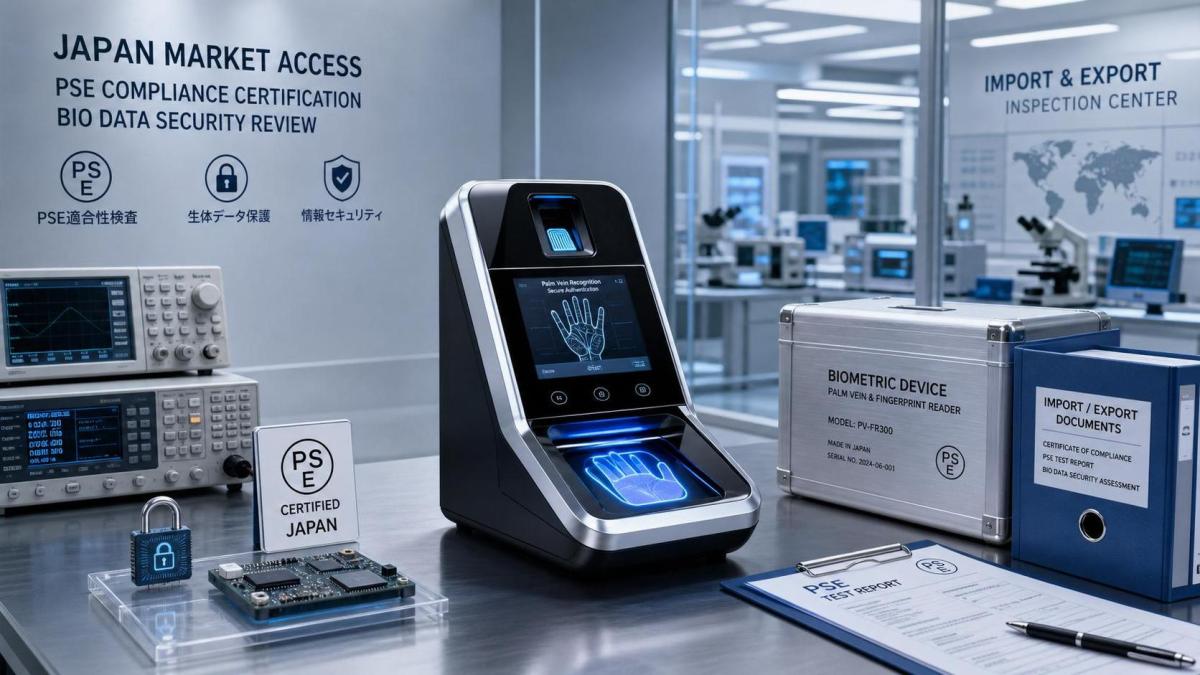
What the revised rule now requires
The confirmed update is that METI revised the detailed implementation rules for PSE certification on June 30, 2026. Under that revision, biometric sensors including fingerprint and palm-vein products were formally added to the Specified Electrical Appliances and Materials list.
The confirmed enforcement point is October 1, 2026. From that date, imported products within this category must pass PSE diamond certification.
The confirmed certification scope also includes a security assessment tied to encrypted storage of biometric templates. The event summary further states that Chinese suppliers holding only the previous round PSE circular certification will not be able to complete customs clearance.
Where the pressure will likely appear across the chain
Export shipments to Japan face a narrower compliance window
From an industry perspective, exporters of biometric sensor products may be affected first because the rule directly changes the import condition for goods entering Japan. The impact is likely to appear in pre-shipment compliance checks, product file review, and the timing of export release. What deserves closer attention is whether products currently prepared under the older circular certification path still match the import requirements after October 1, 2026.
Procurement and sourcing teams may need to reset supplier screening
Buyers and sourcing teams handling biometric sensor components or finished products for the Japanese market may need to recheck supplier qualifications against the revised PSE requirement. The practical issue is not only whether a supplier has a certificate, but whether that certificate is the required PSE diamond certification and whether the supporting materials address biometric template encryption and storage security. In procurement terms, supplier approval, order timing, and acceptance criteria may all need review.
Manufacturers and compliance teams will feel the change in technical files and certification work
Manufacturing enterprises and in-house compliance teams may see the main effect in technical documentation, certification scheduling, and product release planning. Analysis shows that products previously managed under the older certification status may now need a different compliance path before shipment to Japan. For teams already serving Japanese customers, the immediate concern is likely to be the completeness of test materials, security-related design evidence, and the consistency between product specifications and certification scope.
Logistics, customs, and trade service providers may face higher document sensitivity
Supply-chain service providers, customs support teams, and trade operations staff may also be affected because the event summary links certification status directly to customs clearance. Observably, this raises the importance of document review before cargo dispatch. The operational focus is likely to fall on certificate type, supporting declarations, and whether shipment documents align with the updated product classification and import requirement.
What companies should watch before the deadline
Recheck whether in-scope products are still being managed under the old path
Companies supplying fingerprint, palm-vein, or similar biometric sensor products to Japan should first review whether any active product lines are still supported only by the earlier PSE circular certification. Based on the confirmed event summary, that status would create direct customs clearance risk after the new requirement takes effect.
Review certification files against the added security element
The revised requirement expressly includes an assessment of biometric template encryption and storage security. Analysis shows that this point deserves specific attention in compliance review, because it may affect how technical documents, product descriptions, and related testing materials are prepared for certification handling.
Check contracts, delivery schedules, and tender documents for certification wording
For businesses shipping into Japan or supplying Japanese customers, it is more appropriate to understand this change as something that may flow into commercial documents as well as regulatory checks. Companies should watch for updates in purchase specifications, tender requirements, order clauses, and delivery acceptance language tied to PSE diamond certification.
Continue monitoring execution language rather than assuming all details are settled
The confirmed facts establish the revised classification and the import requirement date, but the input does not provide fuller operational detail on execution practice. What deserves closer attention is how official wording, certification handling, and market-side document requests may develop in response to the rule change.
Why this reads as an execution signal
Observably, this update is more than an abstract policy discussion because it connects product classification, certification form, and customs clearance in one chain. That makes it more appropriate to understand the event as an execution-oriented regulatory signal rather than a distant consultation-stage development.
At the same time, analysis shows that the market still needs to watch how the revised requirement is reflected in certification workflows, import documentation practice, and customer-side compliance demands. The current signal is clear on direction, but some practical interpretation may still depend on subsequent implementation language and market feedback.
How the market may best read the change now
At this stage, the most grounded reading is that Japan has raised the entry requirement for imported biometric sensors covered by the revised rule, with a defined shift from older circular certification status to mandatory PSE diamond certification from October 1, 2026. For companies exposed to the Japan market, the issue is less about broad policy sentiment and more about whether product compliance files, supplier qualifications, and shipment planning are aligned in time.
From an industry perspective, this should be treated as a concrete compliance adjustment with immediate relevance to trade preparation, procurement review, and delivery risk control. It is not yet a basis for broad market conclusions beyond the confirmed rule change.
Basis of this article and what still needs verification
This article is based on the user-provided news title, event date, and event summary. For developments of this type, commonly relevant source categories may include official regulatory notices, releases from supervisory authorities, customs or trade administration information, industry association updates, standards-related documents, and reporting by authoritative media.
No specific official source link was provided in the input, so the exact official reference should continue to be verified. Observably, the points that still warrant ongoing attention include detailed implementation language, certification execution practice, changes in tender or procurement documents, market feedback from affected businesses, and how companies adjust their compliance and shipment arrangements in response.
Protocol_Architect
Dr. Thorne is a leading architect in IoT mesh protocols with 15+ years at NexusHome Intelligence. His research specializes in high-availability systems and sub-GHz propagation modeling.
Related Recommendations
- Lina Zhao (Security Analyst)Selecting Capacitive Fingerprint Sensor Modules for Smart Lock Designs
- Lina Zhao (Security Analyst)EU EN 303 645:2026 Mandates DEPT for Exports
- Lina Zhao (Security Analyst)Fingerprint Sensor Modules and RED Compliance: Key Testing Points for EU Market Entry
- Lina Zhao (Security Analyst)FCC Tightens EMC Limits for mmWave Biometric Sensors
- Lina Zhao (Security Analyst)FCC Sets Immediate EMC Limits for mmWave Biometric Sensors
- Lina Zhao (Security Analyst)FCC Adds EMC Limits for mmWave Biometric Sensors
- Lina Zhao (Security Analyst)FCC Tightens Rules for mmWave Biometric Sensors
- Lina Zhao (Security Analyst)FCC Adds SAR Filing Rule for 24-30 GHz Biometric Sensors
- Lina Zhao (Security Analyst)FCC Adds SAR Filing Rule for mmWave Biometric Sensors
- Lina Zhao (Security Analyst)FCC Adds SAR Filing for mmWave Biometric Sensors
Analyst