
Biometric Sensor Application Notes: Power, Accuracy, and Integration
author
How can technical evaluators determine whether a biometric sensor will deliver reliable performance without draining its power budget? These application notes for biometric sensors examine the trade-offs among power consumption, measurement accuracy, and system integration in connected devices. They focus on the test conditions, interface requirements, and environmental factors that matter in smart buildings, wearables, and energy-conscious IoT systems.
The answer rarely sits in one datasheet. A fingerprint reader at a solar-powered facility gate, for example, faces a different set of constraints from an optical pulse sensor in a maintenance worker’s wearable. Both may be described as low-power biometric devices, but their operating cycles, failure modes, and consequences of a missed reading are not interchangeable.
Start with the function, not the sensor headline
“Biometric sensor” covers devices that measure different things. A fingerprint sensor supports identity recognition; a photoplethysmography (PPG) sensor measures optical changes associated with blood flow and may feed heart-rate or blood-oxygen algorithms. An accelerometer can help an algorithm assess motion, but it does not by itself verify identity or establish a medical condition.
Before comparing components, define the system decision: unlock a door, estimate a physiological value, flag poor signal quality, or transmit an observation for later analysis. Then specify how quickly the decision is needed, what happens when the reading is unreliable, and whether the device must continue operating offline.
In an energy-conscious building, a biometric access event might inform an occupancy system. It is still a poor substitute for direct occupancy sensing: one successful entry does not prove that a space remains occupied, and a failed match does not prove it is empty. Keep access control and HVAC decisions separate unless the wider system has a defensible way to resolve those uncertainties.
Calculate energy per useful decision
Standby current is useful, but it is not a battery-life estimate. A realistic power budget includes sensing, processor wake-up, signal processing, storage, radio activity, retries, and the losses introduced by power conversion. For optical devices, LED drive and measurement duration can dominate individual readings; for access devices, a radio exchange or lock actuation may consume more energy than image capture.
A practical starting point is to calculate energy for each operating state: multiply measured voltage by current and time, then sum the states across a representative day. Include unsuccessful attempts, not just successful ones. Converting that energy into estimated battery life also requires usable battery capacity under the actual load and temperature, regulator efficiency, and a margin for aging. For a rechargeable or harvested-energy design, compare consumption with energy genuinely available across unfavorable periods, not only with peak solar-panel output.
Measure at the system supply as well as at the sensor rail. A component may enter deep sleep while its host processor, pull-up resistors, level shifters, or wireless module remain awake. Capture transient current with equipment capable of resolving short peaks; a slow average can hide both supply instability and expensive wake cycles.
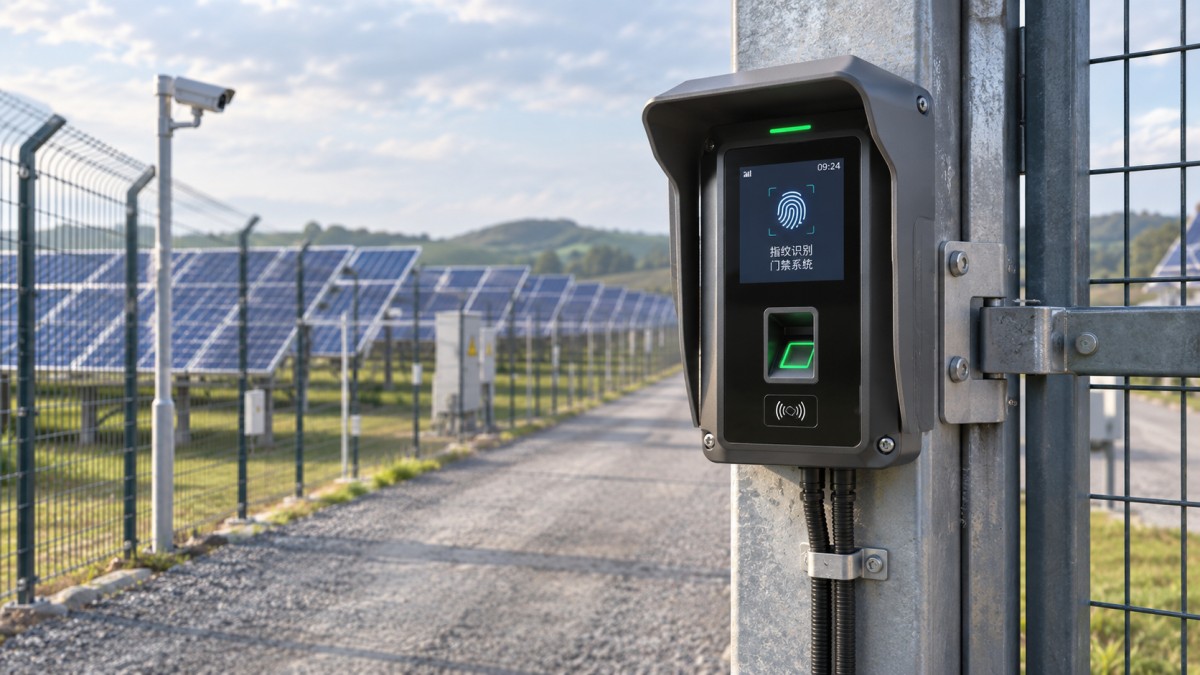
For a solar-assisted gate reader, test an ordinary sequence: wake, capture, match, communicate, actuate, and return to sleep. Then repeat it with a poor fingerprint, a weak radio link, and a depleted battery. Those are different energy events. A design that looks efficient on the first attempt may become expensive when cold fingers or network retries are common.
Accuracy depends on the operating point
For identity recognition, false rejection rate (FRR) describes genuine attempts that are incorrectly rejected; false acceptance rate (FAR) describes impostor attempts incorrectly accepted. These figures depend on the matching threshold, population, capture process, and test protocol. A lower FRR achieved by relaxing the threshold may increase FAR. Comparing two suppliers on FRR alone is therefore misleading.
Ask for the threshold and paired FAR and FRR, the number and nature of attempts, whether repeated attempts were allowed, and how failed captures were counted. Distinguish failure to acquire a usable sample from failure to match one. Both affect the person at the door, but they point to different remedies: sensor placement and capture quality in one case, enrollment or matching behavior in the other.
Environmental testing should reflect the installation. An outdoor reader may encounter moisture, dust, direct sunlight, temperature changes, gloves, and worn or dirty fingers. A reader protected in a lobby should not be judged by exactly the same exposure profile. Test the enclosure and mounting position together with the sensor; a clean component on a bench is not the deployed product.
Physiological measurements need a different comparison
For a wearable PPG system, compare reported values against an appropriate reference under defined conditions. Record motion, contact pressure, placement, ambient light, temperature, and the proportion of time the algorithm declines to report a value. Accuracy calculated only from clean, accepted readings can conceal a device that produces too few usable readings during work.
Performance should also be examined across a representative range of users and use conditions, including relevant skin pigmentation and fit. Sampling rate and LED intensity can improve signal capture in some circumstances, but they also affect power. Reducing them until battery life looks attractive is not a sound trade if the device can no longer meet its intended measurement requirement.
Integration failures often start at the boundaries
Check the electrical interface before assessing wireless compatibility. Supply-voltage range, power-up sequence, peak current, bus voltage, interrupt behavior, and reset timing all affect whether a sensor works reliably with its host. For I²C or SPI, confirm supported bus speeds, logic levels, addressing or chip-select requirements, and behavior when the host sleeps. The reference circuit is a starting point, not proof that the full board will behave identically.
Mechanical integration is equally consequential. An optical module depends on the window material, air gaps, light leakage, contact geometry, and enclosure tolerances. A fingerprint module needs a usable approach angle and a surface that remains readable after cleaning and wear. Validate with production-intent materials; substituting a different cover late in development can change the signal reaching the detector.
At the software boundary, request the driver and algorithm dependencies, supported host platforms, memory requirements, update mechanism, and diagnostic access. Find out whether the supplier delivers raw data, processed features, or only a match decision. That distinction affects validation, privacy, and the ability to replace a component later.
BLE, Zigbee, Thread, and Matter address different parts of a connected system; support for one does not establish end-to-end biometric interoperability. Matter support, where applicable to the device and feature, is not evidence that biometric enrollment, template handling, or access decisions work across vendors. Test the actual device, gateway, and controller combination, including reconnection and offline behavior.
Security, standards, and the limits of a claim
A sensor’s ability to capture a fingerprint or face is not the same as resistance to presentation attacks. Ask whether the complete solution includes presentation attack detection, what attack instruments were tested, and whether the reported result covers the deployed configuration. ISO/IEC 30107-3 addresses testing and reporting of presentation attack detection; citing it is not a substitute for examining the test report, scope, and outcome.
For biometric performance testing, the ISO/IEC 19795 series provides a relevant framework. For a pulse oximeter intended for medical use, ISO 80601-2-61 may be relevant, depending on the product and jurisdiction. Confirm the applicable edition, intended use, regulatory pathway, and any certification requirements rather than treating a component vendor’s standards reference as certification of the finished system.
Map biometric data from capture through deletion. Determine where enrollment occurs, whether templates or raw samples leave the device, how keys are protected, and what happens when a credential is revoked or hardware is replaced. Local processing can reduce data transfers, but it does not automatically establish legal compliance. Privacy obligations depend on the deployment and applicable law.
Build a test record that supports a decision
NexusHome Intelligence’s data-driven approach is a useful principle here: compare claims under observable conditions rather than accepting labels such as “ultra-low power” or “high accuracy.” A concise evaluation record should make it possible for another engineer to repeat the important measurements.
- Define the workload: reading frequency, user attempts, radio conditions, sleep intervals, and expected offline operation.
- Capture the power profile: supply voltage, measurement point, instrument bandwidth, peak current, and energy for successful and failed cycles.
- Record performance conditions: reference method, threshold, sample population, environmental exposure, rejected samples, and retry policy.
- Freeze the configuration: sensor revision, firmware and algorithm versions, enclosure materials, host hardware, and power settings.
- Test recovery: depleted battery, interrupted updates, lost network access, sensor contamination, and fallback access procedures.
The most useful procurement question is not “Which sensor has the lowest current?” It is “Which complete configuration meets the required error rate and availability, under our actual duty cycle, with enough energy margin?” If a supplier cannot provide the conditions behind a performance claim, treat that claim as an open test item—not as a guaranteed system property.
Protocol_Architect
Dr. Thorne is a leading architect in IoT mesh protocols with 15+ years at NexusHome Intelligence. His research specializes in high-availability systems and sub-GHz propagation modeling.
Related Recommendations
- Lina Zhao (Security Analyst)EU Approves Getlink Trial of Drive-Through Biometric Booths for EES Registration
- Lina Zhao (Security Analyst)Burkina Faso Launches Nationwide Biometric Registration for Unique IDs
- Lina Zhao (Security Analyst)Canada Proposes C$90 Million to Expand Travel Biometric Screening
- Lina Zhao (Security Analyst)Biometric Sensor Application Notes: Power, Accuracy, and Integration
- Lina Zhao (Security Analyst)Fingerprint Sensor Modules for Attendance Systems: Key Selection Criteria
- Lina Zhao (Security Analyst)Advance.ai Achieves ISO/IEC 30107-3 Level 3 Biometric Liveness Certification
- Lina Zhao (Security Analyst)HID Agrees to Sell PKI Business to Vista Equity Partners for $58 Million
- Lina Zhao (Security Analyst)Choosing a Wearable Biosensor Module: Power Budgets for Energy Harvesting
- Lina Zhao (Security Analyst)Selecting Capacitive Fingerprint Sensor Modules for Smart Lock Designs
- Lina Zhao (Security Analyst)EU EN 303 645:2026 Mandates DEPT for Exports
Analyst