
Telink Joins CSA Board as Multi-Protocol SoC Output Scales
author
On June 22, 2026, Telink Microelectronics was elected to the board of the Connectivity Standards Alliance, while also moving its Matter, Zigbee, and Aliro-related SoC portfolio into volume production. For smart home device makers, module suppliers, overseas brand customers, and procurement teams, this development is worth watching because it combines standards participation with confirmed shipping readiness across multiple wireless connectivity paths.
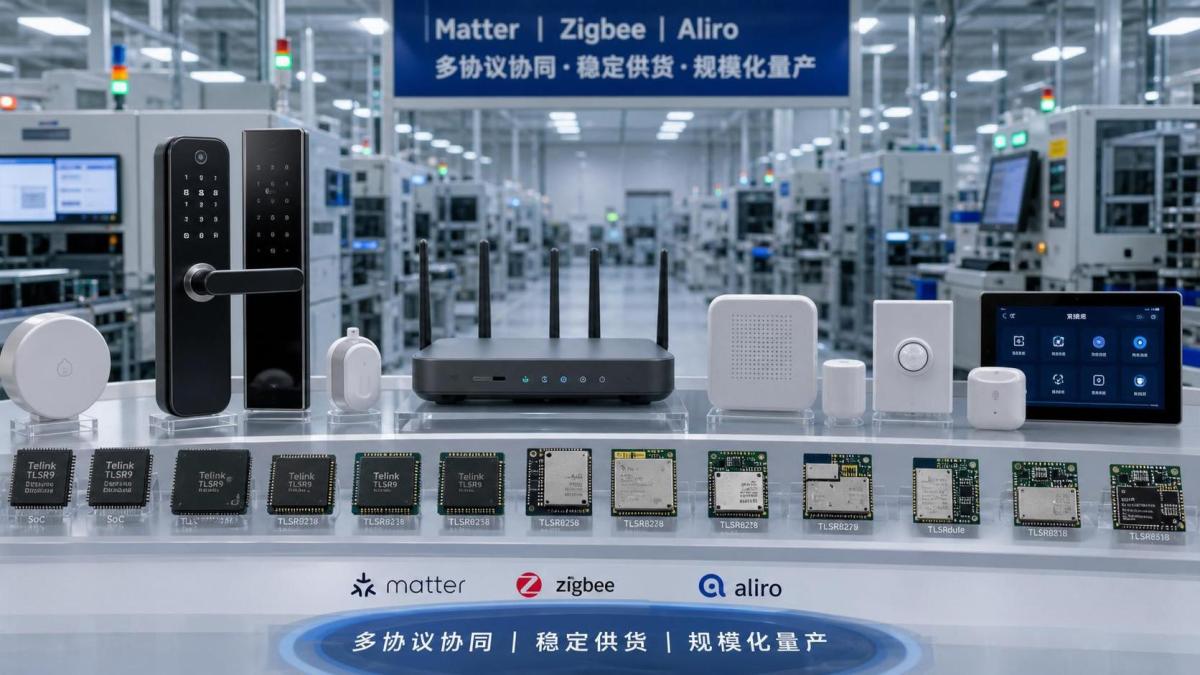
What the announcement confirms
According to the information provided, Telink Microelectronics was formally elected as a board member of the CSA on June 22, 2026. The company has also achieved mass production across three product lines: the TLSR9 series supporting concurrent Matter and Zigbee operation, the TL721X series featuring 1mA ultra-low power consumption and Aliro compatibility, and the high-end TL322X SoC series supporting HDT high-speed transmission.
The same information states that Telink's Matter ecosystem chips account for more than 27% of global whole-home smart terminal shipments, and that the company has become the preferred domestic wireless connectivity solution for overseas brands.
Where the market impact may appear first
Device makers focused on protocol integration
From an industry perspective, smart home terminal manufacturers may be among the first to assess the practical implications of this update. The reason is straightforward: confirmed mass production of SoCs spanning Matter, Zigbee, and Aliro-related use cases may affect product planning, platform selection, and the timing of multi-protocol device launches. What deserves closer attention is whether procurement and R&D teams begin giving more weight to chips that combine standards alignment with production availability.
Module and manufacturing partners watching delivery readiness
For module vendors and electronics manufacturing partners, the potential impact is likely to show up in component selection, qualification schedules, and delivery coordination. Analysis shows that when a chip supplier combines board-level participation in a standards body with multiple product lines already in mass production, downstream partners tend to focus less on roadmap promises and more on lead-time stability, SKU matching, and certification-related documentation.
Overseas brands and channel-facing businesses
For overseas brand owners and channel-facing businesses, the stated shipment share and preferred-solution positioning may influence supplier evaluation and sourcing discussions. Observably, the key issue is not only chip performance, but also whether a supplier can support different product tiers, from low-power applications to higher-throughput scenarios, without forcing repeated platform changes across a portfolio.
What companies should track next
How CSA participation is reflected in future messaging
Companies following this development should watch how Telink's new CSA board role is reflected in future official statements, standards-related communication, and ecosystem positioning. Analysis shows that board membership is a confirmed fact, but its business significance will depend on how that role connects to product support, interoperability claims, and customer-facing technical guidance.
Which product families match actual project needs
Procurement teams and product managers should distinguish clearly between the three confirmed product lines and their stated characteristics: concurrent Matter and Zigbee support in the TLSR9 series, ultra-low-power and Aliro compatibility in the TL721X series, and HDT high-speed transmission in the TL322X series. What deserves closer attention is fit-for-purpose selection rather than treating all three lines as interchangeable options.
Whether supplier documents and delivery plans are sufficient
For sourcing, manufacturing, and account teams, a practical focus should be on supplier qualification materials, technical documentation, delivery commitments, and customer communication readiness. From an industry perspective, once mass production is stated, downstream buyers typically need clearer confirmation on implementation scope, delivery rhythm, and project support materials before adjusting supplier strategies.
The gap between market signal and project execution
Companies should also separate headline-level momentum from actual deployment requirements. Analysis shows that a board appointment and mass-production status can strengthen confidence, but project conversion still depends on product verification, interoperability requirements, and the operational needs of each customer program.
Why this looks like a strategic signal, not a final outcome
Observably, this development is more appropriate to understand as a strategic industry signal than as a complete market conclusion. The combination of CSA board membership, multi-protocol SoC mass production, and a stated shipment position suggests stronger influence in the smart connectivity stack. At the same time, the long-term effect still requires continued observation, especially in how standards participation translates into broader ecosystem acceptance and sustained commercial adoption.
How the industry may read this development for now
At this stage, the most balanced reading is that the announcement points to a deeper link between standards engagement and scalable product supply in the smart home connectivity market. It does not by itself prove a full market shift, but it does indicate that wireless SoC competition is increasingly being judged on both ecosystem positioning and production execution. For industry participants, this is less a short-lived headline than a signal worth tracking over time.
Basis of this article
This article is generated from the user-provided news title, event date, and event summary. Information of this kind is typically cross-checked against official company announcements, statements from industry associations, standard alliance disclosures, authoritative media coverage, and relevant standards-related documents. A specific official source link was not provided in the input, so further verification remains necessary. The main follow-up areas to watch are subsequent official wording, any standards-related updates, and how the confirmed product lines are referenced in future market communication.
Protocol_Architect
Dr. Thorne is a leading architect in IoT mesh protocols with 15+ years at NexusHome Intelligence. His research specializes in high-availability systems and sub-GHz propagation modeling.
Related Recommendations
- Dr. Aris ThorneIEEE 802.15.4z-2026 Sets New UWB Compliance Signal
- Dr. Aris ThorneIEEE 802.15.4z-2026 Sets New Zigbee UWB Test Bar
- Dr. Aris ThorneIEEE 802.15.4z-2026 Sets New UWB Benchmark for Zigbee Tech
- Dr. Aris ThorneIEEE 802.15.4-2026 Lifts Zigbee Mesh to 256 Nodes
- Dr. Aris ThorneZigbee Mesh Capacity in the USA: How Many Devices Can a Network Handle Reliably?
- Dr. Aris ThorneEU Enforces Matter 1.3 for Zigbee Device Imports
- Dr. Aris ThorneTelink Joins CSA Board as Multi-Protocol SoC Output Scales
- Dr. Aris ThorneEU Enforces EN 303 647 v2.1.1 for Zigbee Exports
- Dr. Aris ThorneEN 303 647 v2.1.1 Now Mandatory for Zigbee Devices
- Dr. Aris ThorneGSHE 2026 Adds Matter/Zigbee Sourcing Zone
Analyst