
How to compare palletizing robot suppliers beyond unit price
author
When evaluating palletizing robot suppliers, unit price is only the starting point. For procurement teams in renewable energy, long-term value depends on integration reliability, payload accuracy, uptime, energy efficiency, after-sales support, and data transparency. This guide shows how to compare suppliers with a total-cost and performance mindset, helping you reduce operational risk and choose partners that deliver measurable results beyond the initial quote.
Why procurement teams should use a checklist instead of comparing quotes alone
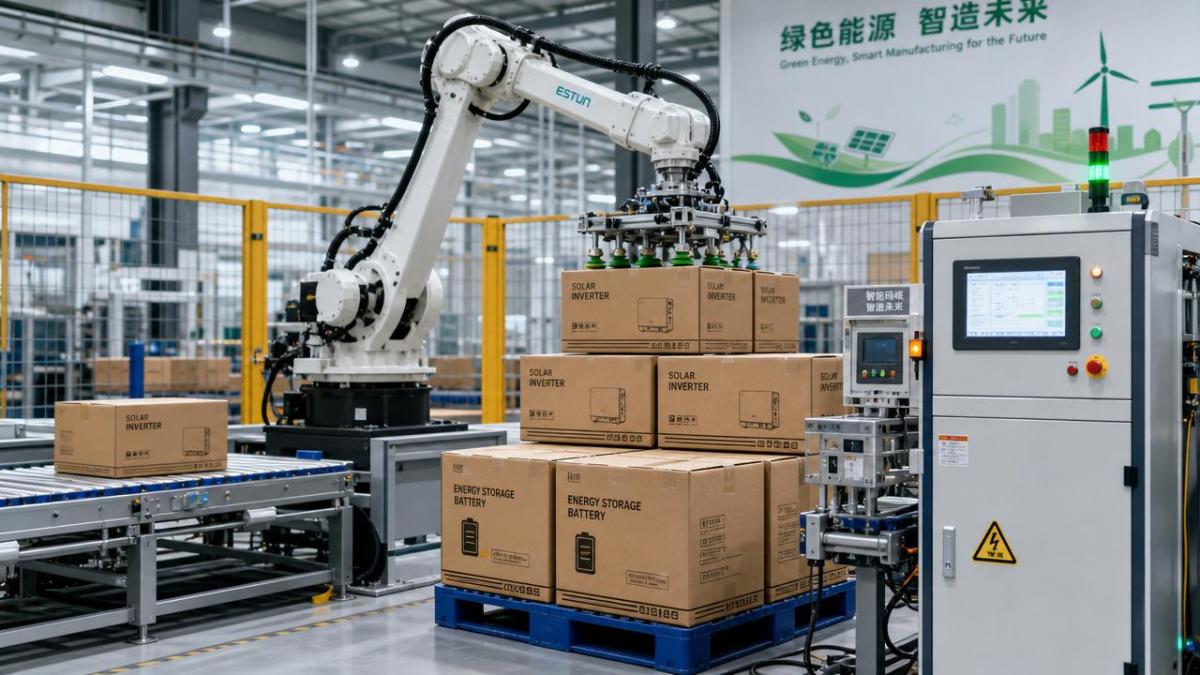
In renewable energy manufacturing and logistics, palletizing is rarely an isolated purchase. It affects packaging flow, warehouse efficiency, labor safety, line uptime, and shipment quality for components such as solar modules, battery packs, inverters, controllers, and smart energy devices. That is why comparing palletizing robot suppliers only by unit price often leads to expensive surprises after installation.
A lower upfront quote can hide higher integration costs, weaker motion control, slower cycle times, poor spare parts access, or limited software compatibility. For buyers managing multi-site operations or scaling production, the real decision is not “Which robot is cheapest?” but “Which supplier can deliver stable throughput, lower lifetime cost, and lower implementation risk?” A checklist approach helps procurement teams compare suppliers on measurable criteria rather than marketing language.
Start with the five questions that screen palletizing robot suppliers fast
Before reviewing technical brochures, ask these priority questions. They quickly separate qualified palletizing robot suppliers from vendors that only compete on price.
- Can the supplier prove performance in a similar application, such as boxed electronics, fragile energy components, or mixed-SKU palletizing?
- What is the verified cycle rate under real load, real end-of-arm tooling, and actual stacking patterns?
- How easily does the system connect with conveyors, vision systems, WMS, MES, PLC, or traceability platforms?
- What service commitment exists for commissioning, spare parts, remote diagnostics, and response time?
- What is the estimated total cost of ownership over three to five years, including energy use, maintenance, training, and software support?
If a supplier cannot answer these clearly, price should not be the deciding factor.
Core evaluation checklist for palletizing robot suppliers
1. Application fit: payload, reach, product stability, and pallet pattern flexibility
The first check is mechanical suitability. Procurement teams should verify whether the robot’s payload rating includes the gripper weight, product weight variation, and safety margin. A system that looks adequate on paper may become unstable when handling battery cartons, inverter housings, or awkwardly sized renewable energy accessories.
Also review maximum reach, stacking height, pattern flexibility, and the ability to handle mixed product dimensions. If your operation expects SKU changes, seasonal packaging variation, or export pallet standards, the chosen supplier must support quick pattern changeovers without requiring major reprogramming.
2. Throughput under real conditions, not brochure conditions
Cycle time claims can be misleading. Ask palletizing robot suppliers for throughput data based on your actual line conditions: product shape, pick orientation, pallet height, infeed spacing, label position, and slip-sheet use. A robot that performs well in a demonstration cell may slow down significantly in a live factory with variable carton quality or unstable upstream flow.
The best suppliers provide simulation results, acceptance criteria, and clear assumptions. Procurement should request performance ranges, not just ideal peak speed.
3. Integration capability with digital manufacturing and energy management systems
For renewable energy operations, automation equipment must fit into a broader data environment. This is where procurement can apply the same data-driven mindset promoted by organizations such as NexusHome Intelligence: claims are not enough; interface reliability and measurable compatibility matter.
Check whether palletizing robot suppliers support common industrial protocols, open communication standards, remote monitoring, and data export. Confirm how the robot exchanges status data, alarms, recipe information, OEE signals, and maintenance logs with your plant systems. If your company values traceability and energy visibility, ask whether the supplier can provide usable data instead of closed, vendor-specific dashboards.
4. Gripper design and packaging quality risk
End-of-arm tooling is often underestimated in supplier comparison. Yet gripper quality strongly affects drop risk, carton deformation, layer alignment, and changeover efficiency. For fragile packaged electronics or battery-related products, poor gripper design can increase hidden damage and customer complaints.
Ask whether the supplier designs tooling in-house, how it manages vacuum loss or slip detection, and whether tooling can be adapted as packaging evolves. A cheap robot with weak tooling can become a costly quality problem.
5. Uptime, maintainability, and spare parts availability
Procurement teams should compare expected uptime, preventive maintenance intervals, mean time to repair, and local spare parts coverage. In fast-moving production, one delayed servo, controller, or gripper component can stop outbound logistics. The question is not only whether parts exist, but where they are stocked and how quickly they can be delivered.
High-quality palletizing robot suppliers typically provide recommended spare parts lists, service level commitments, remote support options, and clear maintenance procedures for operators and technicians.
6. Energy efficiency and operating cost
In the renewable energy industry, buyers are increasingly expected to evaluate operating efficiency, not just capital cost. Ask suppliers for actual power consumption by duty cycle, standby usage, compressed air demand, and the impact of tooling selection. Energy-efficient motion profiles and optimized vacuum systems can reduce long-term running cost, especially across multiple shifts and multiple sites.
This is particularly important for organizations with carbon reporting targets, energy intensity KPIs, or sustainability procurement standards.
A practical comparison table procurement can use
To compare palletizing robot suppliers consistently, use a weighted scorecard instead of informal notes. The sample below can be adapted to your priorities.
Scenario-based checks for renewable energy procurement teams
If you handle fragile, high-value products
Prioritize gentle handling, repeatability, gripper control, and product traceability. Ask palletizing robot suppliers for evidence of successful deployment with delicate packaged goods, not just heavy industrial cartons. Small handling errors can produce large warranty costs.
If you expect line expansion or product diversification
Focus on modular cell design, software scalability, and changeover simplicity. The best supplier is often the one that supports future recipes, second-line duplication, and plant-wide standardization with minimal engineering rework.
If your sites are distributed globally
Compare regional service coverage, multilingual technical support, electrical standard compliance, and documentation quality. Procurement should not assume that a strong local vendor can support overseas rollout at the same level.
Commonly overlooked risks when comparing palletizing robot suppliers
- Ignoring commissioning scope: Some quotes exclude conveyor integration, guarding, software customization, or on-site tuning.
- Comparing robots instead of complete cells: The robot arm may be similar, but controls, tooling, and safety architecture vary widely.
- Overlooking operator usability: Poor HMI design and difficult recipe changes increase dependence on external technicians.
- Missing data transparency: Closed systems make troubleshooting, performance analysis, and site-to-site benchmarking harder.
- Underestimating packaging variation: Real cartons, pallet quality, and environmental conditions may differ from test conditions.
Execution advice: what to request before final supplier selection
Before issuing a purchase order, procurement should prepare a structured request package. This reduces ambiguity and makes supplier comparisons far more accurate.
- Share actual product dimensions, weights, pallet formats, and line throughput targets.
- Request a detailed scope including robot, tooling, controls, guarding, training, and commissioning.
- Ask for a preliminary layout, cycle-time model, and utility requirements.
- Define FAT and SAT acceptance criteria in writing.
- Request a three- to five-year cost model, including consumables, service, and software support.
- Check references from similar industries or packaging environments.
Final decision rule: choose measurable value, not the lowest number
The best palletizing robot suppliers are not always the ones with the lowest unit price. They are the ones that can prove reliable integration, stable throughput, service readiness, energy-aware operation, and transparent lifecycle cost. For renewable energy procurement teams, that difference directly affects output, safety, customer quality, and expansion speed.
If you want to move from quotation comparison to a stronger sourcing decision, prioritize discussion around payload and packaging data, software compatibility, site utilities, service response, spare parts planning, and acceptance standards. Those are the questions that reveal whether a supplier is selling a cheap machine or a dependable long-term solution.
Protocol_Architect
Dr. Thorne is a leading architect in IoT mesh protocols with 15+ years at NexusHome Intelligence. His research specializes in high-availability systems and sub-GHz propagation modeling.
Related Recommendations
- Lina Zhao(Security Analyst)Custom robotic end effectors or standard grippers for fragile parts?
- Lina Zhao(Security Analyst)Palletizing robot suppliers with fast delivery are not always lower risk
- Lina Zhao(Security Analyst)Wholesale LiDAR sensors for autonomous vehicles: what affects accuracy
- Lina Zhao(Security Analyst)Pick and place robot manufacturer choices for high-mix lines
- Lina Zhao(Security Analyst)Custom robotic end effectors that fix repeat pick errors
- Lina Zhao(Security Analyst)How to compare palletizing robot suppliers beyond unit price
- Lina Zhao(Security Analyst)Vision AI Camera Exports to Middle East Surge 37% on Ceasefire Talks
- Lina Zhao(Security Analyst)Vision AI Camera Exports to Middle East Surge 37% in Apr 2026
- Lina Zhao(Security Analyst)Vision AI Costs That Are Easy to Miss in Energy Projects
- Lina Zhao(Security Analyst)When Vision AI Outperforms Manual Wind Turbine Inspection
Analyst