
Custom Robotic End Effectors That Reduce Changeover Time
author
In renewable energy production, every minute of downtime erodes output and raises operating costs. Custom robotic end effectors help operators cut changeover time by improving grip accuracy, part handling, and workflow consistency across fast-shifting manufacturing tasks. For teams focused on reliable performance, these tailored tools offer a practical path to higher efficiency, lower error rates, and more resilient automated operations.
For operators working in solar module assembly, battery pack production, inverter handling, and wind component subassembly, changeover delays are rarely caused by robots alone. More often, the bottleneck sits at the point of contact: the gripper, vacuum head, clamp, tool changer, or sensor-equipped handling unit that touches the part. When that interface is poorly matched to part geometry, surface sensitivity, or takt time, line efficiency can drop by 5% to 15% during product switches.
That is why custom robotic end effectors are becoming a practical investment across renewable energy manufacturing. They support shorter setup windows, more stable part transfer, and better adaptation to mixed-model production. In a sector where operators must handle fragile glass, laminated cells, aluminum frames, cable harnesses, and heavy battery modules within the same facility, customization is often the difference between a 10-minute changeover and a 45-minute interruption.
At NexusHome Intelligence, the focus is always the same: measurable performance over marketing claims. In complex automated environments shaped by IoT data, edge monitoring, and interoperability demands, end-of-arm tooling should be evaluated not by brochure language, but by repeatability, response time, maintenance burden, and integration quality. For renewable energy operators, this data-led view makes procurement decisions safer and daily operation more predictable.
Why Changeover Time Matters in Renewable Energy Automation
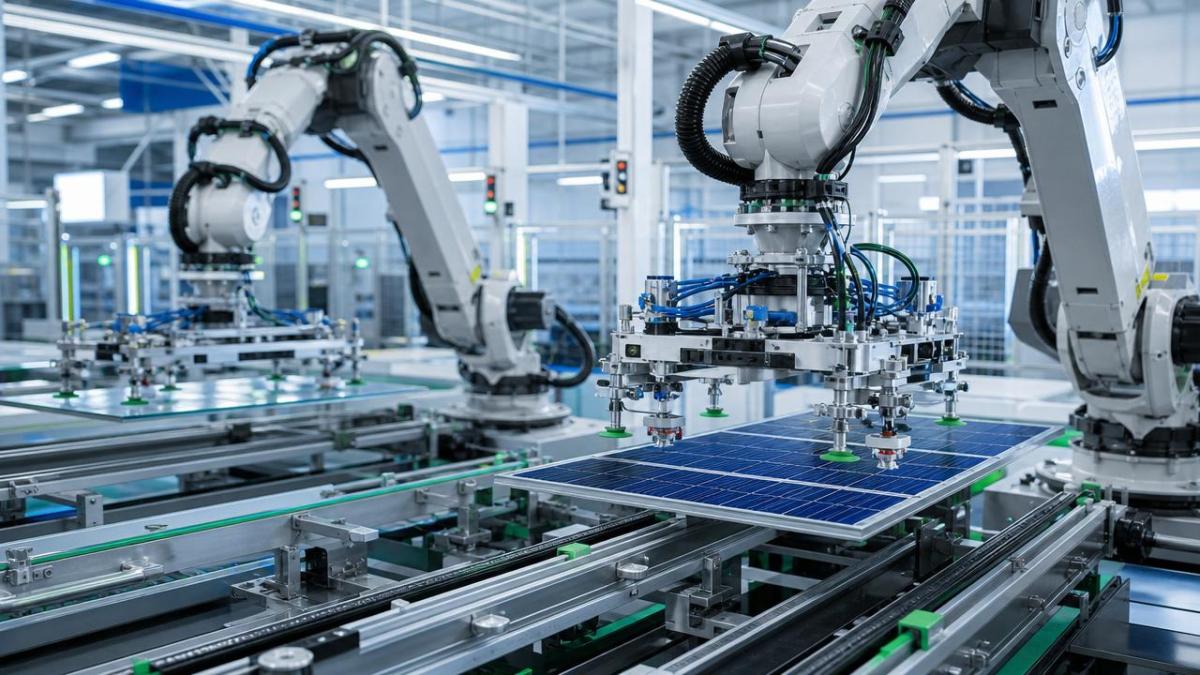
Renewable energy manufacturing is increasingly defined by high product variation and tight production targets. A solar line may switch between cell sizes, frame profiles, and junction box configurations within 1 shift. A battery production cell may handle pouch, prismatic, and module-level assemblies with different gripping and alignment requirements. If operators need 20 to 40 minutes to reconfigure tooling between runs, the hidden cost accumulates quickly across 2 or 3 shifts per day.
Custom robotic end effectors reduce this burden by matching the handling device to the real part, not an average part. Instead of relying on universal grippers that compromise on contact area, stroke, or surface pressure, tailored systems can be designed around part dimensions, center of gravity, fragility thresholds, and orientation logic. This is especially important when handling photovoltaic glass, coated cells, busbar assemblies, and battery housings where damage may not be visible until downstream inspection.
Typical operator pain points during line changeovers
- Manual jaw or suction cup repositioning that takes 8 to 20 minutes per format change
- Part slippage caused by inconsistent vacuum levels or uneven clamping force
- Robot reteaching after each product switch due to poor end-effector repeatability
- Increased scrap when fragile components are gripped with generic contact pads
- Downtime from sensor mismatch between robot controller, PLC, and line-level monitoring systems
Where custom tooling delivers the fastest gains
The strongest return usually appears in applications with frequent SKU changes, delicate materials, or high downstream quality costs. In solar manufacturing, vacuum-based custom robotic end effectors can support more uniform handling of wafers, glass sheets, and finished panels. In battery plants, servo-adjustable grippers can reduce manual intervention when switching between module sizes. In wind-energy component cells, reinforced gripping systems help stabilize heavier parts while keeping alignment within a common tolerance band such as ±0.5 mm to ±1.0 mm.
Three operational signals that a standard gripper is no longer enough
- Changeover takes more than 15 minutes more than twice per shift.
- Scrap or handling defects rise after every format switch.
- Operators keep adding temporary pads, spacers, or manual checks to compensate for unstable gripping.
The table below shows how standard tooling compares with customized solutions in common renewable energy production scenarios.
The key takeaway is not that every process needs a fully complex tool. It is that high-mix renewable energy lines benefit when the end effector is engineered around actual part risk, product variability, and operator workflow. Even a simple custom fixture or modular pad layout can cut changeover time by 30% to 50% in repetitive switching environments.
How Custom Robotic End Effectors Improve Operator Performance
Operators care about results they can see during the shift: fewer stoppages, clearer tool status, less manual adjustment, and stable quality after product changes. Custom robotic end effectors improve these outcomes by bringing mechanical design, sensing, and controls into a single task-specific unit. In smart manufacturing environments, this can also support better machine data visibility through PLC signals, edge devices, or industrial IoT dashboards.
For example, a battery module gripper with integrated position sensors, force monitoring, and tool ID recognition can confirm whether the correct configuration is active before the next cycle begins. That reduces the chance of misloaded parts and helps operators diagnose a fault in 2 to 5 minutes instead of tracing the issue across several line components. In facilities where OEE targets are reviewed daily, this level of feedback matters.
Core design features that support faster changeovers
- Quick-change interfaces that allow tool swaps in under 3 minutes
- Adjustable gripping zones for multiple part sizes within a shared platform
- Embedded sensors for vacuum, force, part presence, and jaw position
- Lightweight materials that reduce robot payload burden and cycle lag
- Cable and air routing designed for easier maintenance access
Integration with connected production systems
NHI’s broader view of industrial ecosystems is relevant here. Tooling is no longer an isolated hardware item. In advanced renewable energy plants, the end effector often needs to communicate with robot controllers, machine vision, MES layers, and condition-monitoring platforms. If protocols or sensor outputs are poorly matched, operators may face nuisance alarms, delayed fault acknowledgment, or unreliable part confirmation.
A better approach is to specify data points from the start: response time, signal type, cycle count logging, and acceptable latency thresholds. For many applications, even a 100 to 200 millisecond delay in confirmation signals can affect high-speed pick-and-place cells. In lower-speed heavy handling, stability and diagnostic clarity may matter more than raw speed. The right custom robotic end effectors are designed around that context, not just gripping force.
Operator-focused benefits beyond cycle time
- Lower training burden because setup steps are standardized
- Less ergonomic strain from manual tool adjustment
- More predictable inspection outcomes after product switches
- Cleaner troubleshooting using sensor-based status feedback
The following table outlines practical selection criteria for operators and production teams evaluating custom tooling for renewable energy lines.
These benchmarks help separate genuinely useful custom robotic end effectors from overbuilt tools that add complexity without improving line output. The best design is usually the one that removes one or two recurring bottlenecks and keeps the operator workflow simple.
What to Consider Before Buying Custom Tooling
Procurement in renewable energy automation should start with process evidence, not catalog features. Before requesting a quote, operators and engineers should define at least 4 items: part range, surface sensitivity, required cycle time, and existing control architecture. Without this baseline, suppliers may recommend custom robotic end effectors that fit the robot flange but not the production reality.
Five questions to ask suppliers
- How will the tool handle the smallest and largest part variants without manual rework?
- What consumable items require replacement, and at what expected interval?
- Can the sensor outputs integrate with the plant’s current PLC or edge monitoring layer?
- What is the expected lead time for design, prototyping, and final commissioning: 2 weeks, 6 weeks, or longer?
- What acceptance tests will be performed under real payload, speed, and environmental conditions?
Common mistakes that increase lifecycle cost
One common mistake is choosing the lightest tool without reviewing structural stiffness. In battery and inverter handling, a lower mass tool may still create positioning issues if deflection increases under acceleration. Another mistake is ignoring cable protection and service access. A tool that saves 30 seconds in cycle time but requires 90 minutes of maintenance disassembly every month is not a productivity win.
A third issue is incomplete data integration. As NHI consistently emphasizes across industrial ecosystems, hardware value depends on verifiable performance. If custom robotic end effectors cannot provide reliable status signals, cycle counts, or fault traces, the operator loses diagnostic visibility. In connected renewable energy factories, that can delay root-cause analysis and reduce trust in the automation cell.
Practical procurement checklist
- Request sample-part testing for at least 3 product variants
- Confirm tool change procedure and average swap time
- Review spare parts list for the first 12 months
- Verify signal compatibility and maintenance documentation
- Ask for a clear acceptance plan tied to actual production conditions
Implementation, Maintenance, and Long-Term Reliability
A successful deployment does not end at installation. For renewable energy manufacturers, the strongest long-term results come from a 3-stage rollout: pilot validation, controlled production ramp, and routine performance review. During the pilot stage, operators should track setup time, grip faults, part damage, and recovery steps. During ramp-up, teams should validate performance over multiple shifts, not only during daytime engineering support hours.
Maintenance planning is equally important. Vacuum cups, friction pads, seals, and sensor connectors are wear items, especially in dusty, adhesive-heavy, or temperature-variable environments. A realistic preventive schedule may include daily visual checks, weekly cleaning, and a deeper inspection every 250 to 500 hours. In lines producing solar or battery components around the clock, this prevents gradual performance drift from becoming unplanned downtime.
How connected diagnostics improve uptime
When tooling health data is shared with the broader automation system, operators gain earlier warning of wear or instability. Examples include vacuum pressure trending, cycle count thresholds, abnormal force signatures, or repeated recovery sequences. This is where NHI’s data-driven philosophy aligns with factory reality: measurable hardware behavior leads to better operational decisions. In an era of fragmented protocols and mixed industrial devices, transparent diagnostic data is more valuable than broad claims of compatibility.
When to redesign instead of repair
If a tool requires repeated operator workarounds, redesign may be more economical than endless maintenance. Warning signs include more than 3 unscheduled stoppages per week, repeated pad replacement below expected life, or the need to manually align parts before every pick. In these cases, custom robotic end effectors should be reviewed as part of the process, not as isolated hardware. Sometimes a revised contact surface, sensor position, or quick-change geometry can solve what appears to be a robot programming issue.
A Practical Path Forward for Renewable Energy Operators
Custom robotic end effectors are not only for highly complex robotic cells. They are a practical upgrade for renewable energy manufacturers trying to reduce changeover time, stabilize product handling, and make automation easier for operators to manage across shifting part formats. When designed with the right mechanical, sensing, and integration logic, they can reduce manual steps, support more consistent quality, and improve uptime without unnecessary complexity.
For teams evaluating tooling in solar, battery, inverter, or wind-related production, the most effective next step is to document the current bottleneck in measurable terms: setup minutes, defect frequency, grip failures, and maintenance interruptions. From there, a data-led review of custom robotic end effectors can reveal where a tailored solution will deliver the strongest operational return.
If you want to assess changeover risks, compare tooling approaches, or build a more reliable automation strategy for renewable energy production, contact us to discuss your application, request a custom solution, and explore more data-driven manufacturing options.
Protocol_Architect
Dr. Thorne is a leading architect in IoT mesh protocols with 15+ years at NexusHome Intelligence. His research specializes in high-availability systems and sub-GHz propagation modeling.
Related Recommendations
- Lina Zhao(Security Analyst)US-Iran Ceasefire Spurs Vision AI Demand in Middle East
- Lina Zhao(Security Analyst)China Cycle 2026: Wi-Fi 7 IoT & Vision AI Safety Systems in Focus
- Lina Zhao(Security Analyst)When 6 Axis Robot Arm Wholesale Deals Stop Being a Bargain
- Lina Zhao(Security Analyst)6 Axis Robot Arm Wholesale: Which Specs Change Total Cost?
- Lina Zhao(Security Analyst)The Most Common Payload Mistake in 10kg Cobot Selection
- Lina Zhao(Security Analyst)Is a 10kg Collaborative Robot Payload Enough for End-of-Line Work?
- Lina Zhao(Security Analyst)When Custom Robotic End Effectors Cost More Than Expected
- Lina Zhao(Security Analyst)Custom Robotic End Effectors That Reduce Changeover Time
- Lina Zhao(Security Analyst)Why Some Pick and Place Robot Manufacturers Miss Accuracy Targets
- Lina Zhao(Security Analyst)How to Judge a Pick and Place Robot Manufacturer by Cycle Time
Analyst