
Micro-Sensors That Improve Wind Turbine Condition Tracking
author
In renewable energy operations, condition tracking depends on sensor data that remains stable under vibration, weather stress, and long service cycles. Micro-sensors are becoming essential for smarter wind turbine diagnostics, while lessons from precision hardware fields such as custom robotic end effectors highlight why accuracy, durability, and integration matter. This article explores how technical evaluators can assess sensor performance beyond marketing claims to support more reliable turbine monitoring.
Why are micro-sensors attracting so much attention in wind turbine condition tracking?
Wind turbines operate in a harsh mix of rotating loads, moisture, salt, temperature swings, and intermittent grid demand. Traditional inspection schedules often identify problems only after wear has advanced, which raises downtime, crane costs, and safety risk. Micro-sensors change this model by enabling dense, distributed measurement close to the source of stress. Instead of relying only on periodic visual checks or a small number of centralized instruments, operators can track vibration, temperature, strain, tilt, acoustic signatures, lubrication condition, and power electronics behavior in near real time.
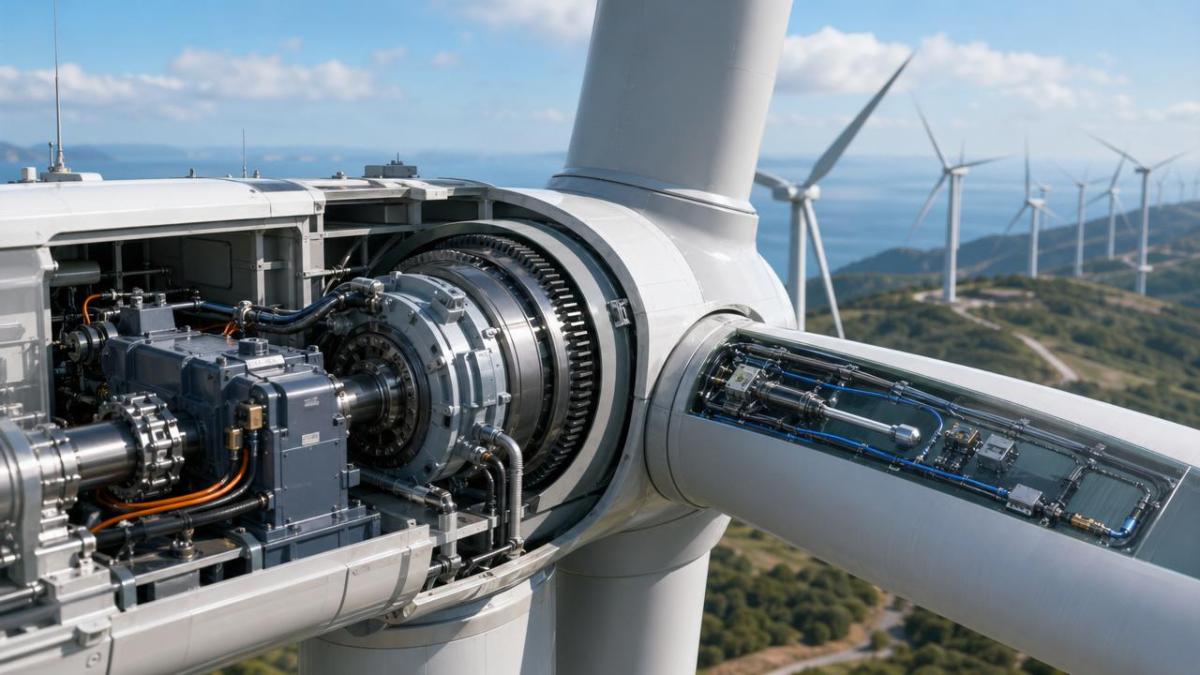
For technical evaluators, the interest is not simply that sensors are smaller. The real value is that small form factors can be installed in areas where larger devices are difficult to place, such as blade interiors, gearbox housings, generator sections, pitch systems, nacelle subsystems, and auxiliary electronics. That broader sensing coverage improves fault isolation. It also supports predictive maintenance models that connect subtle deviations with future failure modes.
The comparison with custom robotic end effectors is useful here. In both fields, hardware succeeds only when precision, environmental fitness, repeatability, and system compatibility are engineered together. A sensor that looks impressive on a datasheet but drifts under vibration is no more valuable than a robotic gripper that loses alignment under production load. Technical buyers in renewable energy increasingly recognize that condition tracking quality depends on engineering truth, not broad claims.
What exactly should technical evaluators measure when comparing micro-sensors?
The first mistake is to compare only nominal sensitivity or price. In wind turbine monitoring, the decisive question is whether the sensor keeps producing trustworthy data after months or years of real operating stress. That means evaluators should review performance across five layers: signal quality, long-term stability, environmental durability, integration burden, and diagnostic usefulness.
Signal quality includes noise floor, dynamic range, resolution, sampling consistency, and response time. A vibration sensor with poor noise behavior may miss early bearing faults. A temperature sensor with slow response may hide thermal spikes in converters or brake systems. Long-term stability includes calibration drift, offset variation, hysteresis, and repeatability across thermal cycles. Environmental durability should cover ingress resistance, corrosion risk, UV tolerance where relevant, shock endurance, and survivability under nacelle or blade vibration.
Integration burden is just as important. Buyers should ask whether the sensor supports standard industrial interfaces, edge processing, low-power operation, synchronized sampling, and reliable gateway communication. This is where the philosophy behind custom robotic end effectors becomes relevant again: precision components create value only when they fit cleanly into the larger system architecture. A technically advanced sensor that complicates firmware, maintenance access, or data mapping may increase total lifecycle cost instead of reducing it.
For teams already familiar with custom robotic end effectors, this evaluation logic will feel familiar: application fit matters more than isolated headline specs.
Which turbine subsystems benefit most from micro-sensor deployment?
Not every turbine area needs the same sensor density. Technical evaluators should prioritize subsystems where early anomaly detection prevents expensive secondary damage. The gearbox remains one of the most valuable targets because small shifts in vibration patterns, temperature, lubrication debris, or acoustic behavior can signal wear well before major failure. Bearings, shafts, and couplings also benefit from compact sensing because fault signatures often emerge gradually and are difficult to spot with coarse monitoring alone.
Blades are another high-impact area. Strain, deflection, icing indicators, and structural vibration data can improve both health monitoring and performance optimization. In offshore environments, where access windows are limited, blade-embedded or blade-adjacent micro-sensors can provide much earlier warnings. Power electronics, converters, transformers, braking systems, and yaw or pitch actuators are equally important for modern fleets because intermittent overheating or alignment issues may not appear during routine inspections.
The practical lesson is to align deployment with failure economics. If a component’s failure leads to crane mobilization, long outage duration, or collateral damage, denser sensing is usually justified. This decision method parallels custom robotic end effectors selection in advanced automation: investment should go where precision most strongly protects uptime, throughput, and safety.
How can buyers separate real sensor performance from marketing language?
This is one of the most common concerns among technical evaluation teams. Many suppliers describe their devices as rugged, intelligent, or maintenance-free, but those terms mean little without test conditions and measurable thresholds. Buyers should request evidence from accelerated life testing, vibration endurance trials, ingress and corrosion testing, calibration retention reports, and field deployment references that resemble the target site conditions.
Ask for data, not slogans. What is the documented drift after thermal cycling? What happens to signal quality after prolonged high-frequency vibration? How is timestamp integrity preserved during network interruption? Can the vendor show performance in offshore salt exposure or desert temperature swings? If edge analytics are included, how often must models be retrained, and how are false alarms managed? These questions force the discussion toward engineering evidence.
Another useful tactic is to validate the entire chain rather than the sensing element alone. Condition tracking is only as good as sensor mounting, signal conditioning, transmission reliability, power management, and software interpretation. A high-grade MEMS device can still produce poor outcomes if installation geometry is wrong or if the gateway drops packets during peak interference. In complex hardware environments, including custom robotic end effectors and turbine diagnostics, system-level validation is the only credible standard.
What are the most common mistakes when selecting micro-sensors for turbine monitoring?
A frequent mistake is overvaluing miniaturization and undervaluing reliability. Small size is helpful, but not if it compromises sealing, thermal robustness, battery life, connector integrity, or maintainability. Another mistake is assuming that more channels automatically mean better condition tracking. Excess low-value data can overwhelm analysts and machine learning workflows, especially when sampling is not aligned with known failure modes.
Technical evaluators also sometimes treat laboratory calibration as a substitute for field realism. A sensor that performs well in controlled conditions may behave differently once bonded to composite blades, exposed to oil mist, or mounted near electromagnetic noise sources. Ignoring installation mechanics is another risk. Mounting method, adhesive aging, cable strain relief, and mechanical coupling can distort measurements as much as the sensor itself.
There is also a procurement-side error: choosing the lowest upfront unit cost without modeling lifecycle impact. If replacement intervals are short, false alarms are high, or integration engineering becomes complex, the cheapest option can become the most expensive. The same discipline used when specifying custom robotic end effectors should apply here: evaluate total operational value, not just purchase price.
How should teams compare wired, wireless, and hybrid sensor architectures?
There is no universal best architecture. Wired sensors remain strong where power availability, deterministic communication, and high sampling fidelity are critical. They are often preferred for permanent installations in nacelles, gearboxes, and generator zones where maintenance access is manageable and cable routing is protected. Wireless options can reduce installation complexity and open access to rotating or remote locations, but they demand close evaluation of battery life, packet reliability, synchronization, security, and interference resilience.
Hybrid designs are increasingly practical. In these systems, critical channels use wired infrastructure while supplementary measurements rely on wireless nodes or edge aggregators. This approach can balance reliability with deployment flexibility. For technical evaluators, the decision should rest on data criticality, expected maintenance interval, environmental exposure, retrofit complexity, and cybersecurity requirements.
Again, the analogy to custom robotic end effectors is useful. In automation, the best end effector is not the one with the most features; it is the one that fits payload, cycle time, accuracy, and maintenance conditions. In wind energy, the best sensor architecture is the one that preserves data trust under real operating constraints.
What should be confirmed before pilot deployment, procurement, or supplier cooperation?
Before moving forward, technical evaluators should define the specific failure modes they want to detect, the minimum actionable lead time, and the operational decision each data stream is expected to support. That prevents the common problem of collecting large volumes of data without a maintenance response model. Next, confirm environmental boundaries, installation location constraints, power strategy, communication pathway, and software compatibility with SCADA, CMMS, or analytics platforms.
It is also wise to request a pilot plan with success criteria. That plan should include baseline measurements, acceptable drift thresholds, alarm logic, maintenance workflow integration, and review intervals. Ask suppliers how firmware updates are managed, how failed nodes are replaced, what calibration support is available, and what evidence links the sensor output to actual fault classification accuracy.
For organizations influenced by high-precision sourcing models such as custom robotic end effectors, the strongest purchasing approach is evidence-led comparison. Look for suppliers that can translate technical capability into verified benchmarks, not just brochures. In renewable energy, trustworthy condition tracking depends on components that are accurate, durable, interoperable, and honest about their limits.
Which quick questions belong on every evaluator’s checklist?
A concise checklist can save weeks of back-and-forth. Ask these questions early: What failure mode is this sensor best at detecting? What is the proven drift rate over time? Under what vibration and thermal conditions was it tested? How is data synchronized and transmitted? What maintenance interval is expected? How is sensor replacement handled in the field? What false alarm rate has been observed in comparable wind projects? Can the supplier share integration references or benchmark reports?
These are the same kinds of practical, engineering-first questions that buyers use when evaluating custom robotic end effectors for demanding industrial environments. The principle is consistent: reliable performance is a measurable outcome, not a marketing promise.
If you need to confirm a specific wind turbine monitoring approach, a retrofit path, a testing scope, or a supplier comparison framework, start by discussing target failure modes, site conditions, communication constraints, expected service life, and benchmark evidence. Those conversations will reveal far more than generic claims and help technical evaluators choose micro-sensors that genuinely improve condition tracking.
Protocol_Architect
Dr. Thorne is a leading architect in IoT mesh protocols with 15+ years at NexusHome Intelligence. His research specializes in high-availability systems and sub-GHz propagation modeling.
Related Recommendations
- NHI Data Lab (Official Account)Micro-Sensor Failures That Distort Energy Performance Data
- NHI Data Lab (Official Account)Are Micro-Sensors Reliable in Utility-Scale Solar Fields?
- NHI Data Lab (Official Account)Micro-Sensors That Improve Wind Turbine Condition Tracking
- NHI Data Lab (Official Account)Vietnam Drafts New Rule: Chinese Sensor Makers Must Submit Stack Source Code Declaration
- NHI Data Lab (Official Account)Vietnam Drafts New Rule: Chinese Smart Sensor Imports Must Submit Protocol Stack Source Code Declaration
- NHI Data Lab (Official Account)Vietnam Proposes New Rule: Chinese-Origin Tech White Paper Required for Smart Sensor Imports
- NHI Data Lab (Official Account)Vietnam to Require Chinese Tech White Papers for Smart Sensor Imports
- NHI Data Lab (Official Account)Why smart home micro-sensors drift sooner in real environments
- NHI Data Lab (Official Account)Vietnam Proposes New Rule: Chinese-Origin Tech White Paper Required for Smart Sensor Imports
- NHI Data Lab (Official Account)Why Some Smart Home Micro-Sensors Drift Too Fast
Analyst