
Best LiPo Battery for Wearables in 2026
author
Choosing the best LiPo battery for wearables in 2026 means looking beyond capacity labels to real discharge stability, safety, and lifetime under IoT workloads. For engineers, buyers, and decision-makers in renewable energy and smart device ecosystems, this guide examines how lipo battery for wearables performance connects with BLE power efficiency, nbiot module battery life, and long-term reliability in data-driven product development.
For most buyers and product teams, the best LiPo battery for wearables in 2026 is not simply the one with the highest mAh rating. It is the cell that fits the device mechanically, remains stable under pulse loads, survives hundreds of charge cycles, passes safety and transport requirements, and supports the real wireless duty cycle of the product. In practice, wearable battery selection should be based on five factors first: form factor, usable capacity under peak current, protection design, cycle/calendar life, and supplier consistency.
If your product includes BLE, low-power sensors, edge AI functions, or intermittent cellular communication, battery behavior under dynamic current draw matters more than brochure claims. That is why engineers, sourcing teams, and enterprise evaluators should treat a lipo battery for wearables as a system-level component, not a commodity part.
What actually makes a LiPo battery “best” for wearables in 2026?
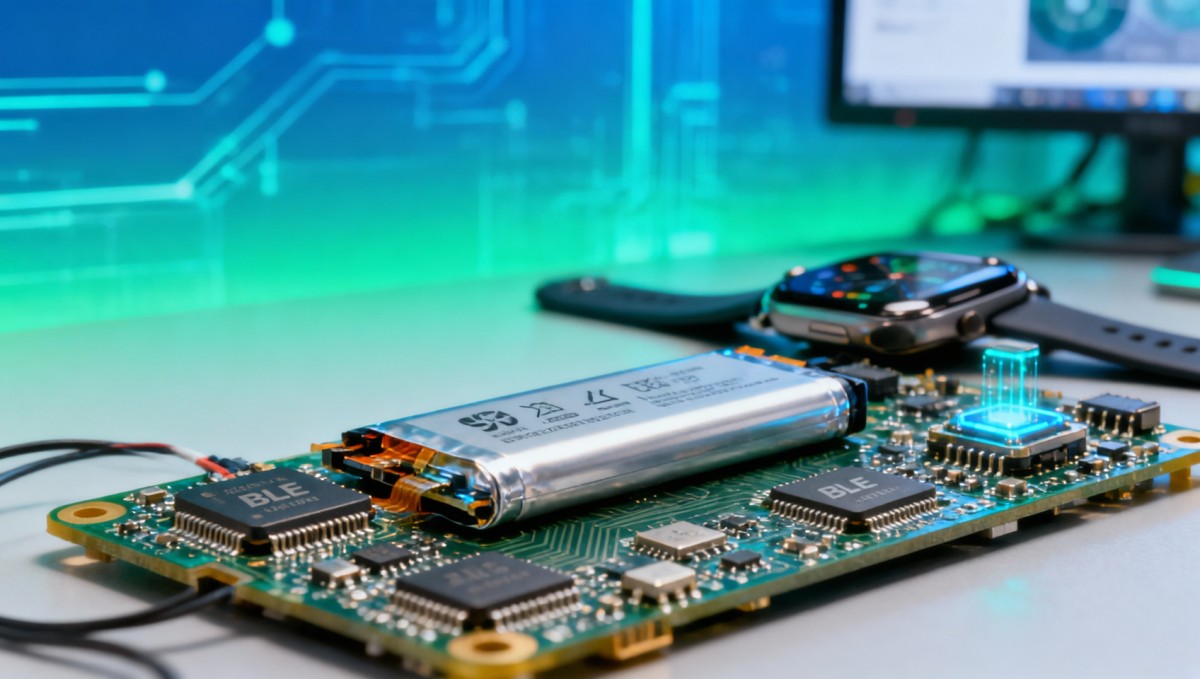
In 2026, the market is more mature, but also more crowded. Many cells look similar on paper. The real differences appear when batteries are tested in realistic wearable conditions: frequent charging, irregular load peaks, thin enclosures, body heat exposure, and always-on connectivity.
The best LiPo battery for wearables usually meets the following requirements:
- Compact mechanical fit: Ultra-thin pouch cells must match industrial design constraints without swelling risk.
- Stable voltage under pulse load: Important for BLE transmission bursts, haptic motors, GNSS, or NB-IoT uplinks.
- Reliable protection circuit integration: Overcharge, over-discharge, and short-circuit protection are essential.
- Low self-discharge: Critical for devices that spend long periods in standby or warehouse storage.
- Strong cycle life: Especially relevant for smart watches, medical wearables, and industrial monitoring bands.
- Thermal stability: Wearables are close to skin and often sealed, so heat must be tightly controlled.
- Manufacturing consistency: Cell-to-cell variation directly affects field failure rates and customer satisfaction.
For business decision-makers, “best” should also include procurement resilience. A battery supplier may offer attractive pricing, but if thickness tolerance, tab placement, or lead time consistency are poor, the total project cost rises quickly through redesigns, returns, and delayed launches.
Which battery specs matter most for wearable devices?
Many teams focus too heavily on nominal capacity. Capacity matters, but on its own it is not enough. The more useful evaluation framework is below.
1. Capacity vs. usable capacity
A 200 mAh cell that collapses under pulse load may deliver worse real-world runtime than a 180 mAh cell with lower internal resistance. Always ask for discharge curves under realistic current patterns, not just standard lab conditions.
2. Internal resistance
Low internal resistance improves voltage stability and reduces heat. This is especially important in wearables with radios, microprocessors, LEDs, or biometric sensors that create short, repeated current peaks.
3. Thickness tolerance
In slim wearables, even small thickness variation can affect assembly yield or enclosure stress. This is a hidden but commercially important metric.
4. Charge/discharge rate
Fast charging may be a product requirement, but not every small LiPo cell handles it well. If your user experience depends on quick top-ups, verify temperature rise, cycle degradation, and charge efficiency under your intended charging profile.
5. Cycle life and calendar life
Some devices are recharged daily, while others are charged once a week. The expected replacement cycle should align with the product warranty, service plan, and brand promise.
6. Safety certification and transport compliance
UL, IEC, UN38.3, RoHS, and related compliance requirements are not paperwork details. They affect logistics, market access, insurance risk, and customer trust.
How wearable power profiles affect battery choice
Different wearable categories need different battery strategies. A one-size-fits-all approach often leads to poor performance or overengineering.
Smart watches and fitness bands
These products typically combine always-on sensors, BLE, vibration alerts, and display activity. The ideal battery needs balanced energy density, low impedance, and tolerance for frequent shallow charging.
Medical and health monitoring wearables
Here, reliability often matters more than maximum runtime. Continuous glucose monitors, ECG patches, SpO2 wearables, and elderly care devices need predictable discharge behavior and very low failure risk. Safety margin should be higher, and qualification testing should be stricter.
Industrial and worker safety wearables
These may experience temperature variation, vibration, longer storage periods, and intermittent high-power communications. In such cases, nbiot module battery life becomes a key design constraint, because cellular bursts can create much larger power spikes than BLE.
Smart textiles and ultra-thin form factors
For flexible or body-conforming products, packaging design and mechanical resilience are as important as electrical performance. The battery must tolerate repeated motion and limited internal space without deformation issues.
BLE power efficiency and its relationship to LiPo battery performance
Many wearable teams underestimate how strongly radio strategy affects battery selection. BLE power efficiency is not just a firmware issue; it directly changes which battery profile will perform best.
For BLE-centric wearables, battery selection should account for:
- Advertising interval and connection interval
- Transmission power level
- Packet retry frequency in noisy environments
- Sensor polling strategy
- Display wake behavior
- Sleep current of the full system, not just the MCU
If the firmware is optimized, a smaller battery may be sufficient. If the radio stack is chatty or the device operates in interference-heavy environments, the battery experiences more frequent micro-pulses and voltage sag. This is why battery benchmarking should happen alongside protocol and firmware testing, not after hardware selection is already frozen.
For NHI-style data-driven evaluation, the useful question is: How does the battery behave under the actual BLE duty cycle of the finished device? That answer is more valuable than nominal capacity alone.
What changes when the wearable uses NB-IoT or hybrid connectivity?
Compared with BLE-only wearables, products using NB-IoT, LTE-M, or hybrid wireless architectures place much heavier demands on the battery. This is where many sourcing errors happen.
When evaluating nbiot module battery life, teams should pay close attention to:
- Peak current support: Cellular uplink bursts can stress small cells significantly.
- Voltage sag tolerance: Some systems reset if battery voltage dips during transmission.
- Temperature impact: Outdoor or remote wearables may transmit in harsher conditions.
- Aging behavior: A battery that performs well when new may fail after several months of field use.
In these scenarios, the best LiPo battery for wearables is often not the thinnest possible option, but the one that maintains stable system voltage throughout the full service life. A slightly larger cell can reduce resets, improve data reliability, and lower support costs.
How to evaluate battery suppliers beyond the datasheet
For procurement teams and enterprise buyers, supplier quality is often more important than single-sample performance. A good qualification process should include both engineering metrics and supply chain checks.
Ask for these data points
- Batch consistency data
- Swelling performance after accelerated aging
- Internal resistance distribution across production lots
- Cycle life test conditions and end-of-life definition
- High-temperature storage results
- Protection circuit specifications
- UN38.3 and relevant certification documents
Verify these commercial realities
- Lead time stability
- MOQ flexibility for pilot and scale phases
- Custom tab/wire/connector options
- Change notification policy
- Traceability and lot coding
- Failure analysis support
This is especially important in global IoT and renewable energy-linked ecosystems, where wearables may be part of broader monitoring, access control, health, or workforce efficiency systems. The battery is small, but its failure can undermine the whole data pipeline.
Common mistakes when choosing a lipo battery for wearables
Several battery selection errors continue to appear across wearable projects:
- Choosing based only on mAh label
- Ignoring pulse load behavior
- Underestimating enclosure pressure and swelling risk
- Skipping low-temperature and high-temperature validation
- Testing battery performance separately from firmware and radio behavior
- Using supplier sample data as a proxy for mass production consistency
- Not aligning cycle life with warranty expectations
These mistakes create downstream issues that are expensive to fix: field returns, unstable connectivity, inconsistent runtime, charging complaints, and damaged product reputation.
A practical shortlist framework for engineers and buyers in 2026
If you need a faster selection process, use this shortlist framework:
- Define the real power profile: standby current, radio bursts, sensor duty cycle, display usage, charging behavior.
- Set mechanical limits: thickness, area, connector orientation, flex constraints.
- Choose 3–5 candidate cells: based on chemistry maturity, supplier credibility, and form factor.
- Run device-level validation: not bench-only testing.
- Compare under aging conditions: especially for medical, industrial, and enterprise deployments.
- Audit supply stability: because commercial continuity is part of battery quality.
For enterprise decision-makers, this method helps turn battery sourcing from a low-visibility component choice into a measurable risk-control process.
Final recommendation: what is the best LiPo battery for wearables in 2026?
The best LiPo battery for wearables in 2026 is the one that delivers the most stable real-world performance in your exact device architecture, not the one with the most attractive headline specification. For BLE wearables, prioritize low internal resistance, low self-discharge, and cycle stability. For devices where nbiot module battery life is critical, prioritize voltage stability under peak current and long-term reliability under aging.
For engineers, the key is integrated testing. For buyers, the key is supplier consistency. For business evaluators and decision-makers, the key is total lifecycle value: lower failure rates, predictable runtime, compliance readiness, and fewer product support issues.
In short, wearable battery selection in 2026 should be data-led, application-specific, and tied directly to connectivity behavior, service life, and deployment risk. That is how teams move beyond marketing claims and make battery decisions that support both product performance and business outcomes.
Protocol_Architect
Dr. Thorne is a leading architect in IoT mesh protocols with 15+ years at NexusHome Intelligence. His research specializes in high-availability systems and sub-GHz propagation modeling.
Related Recommendations
- NHI Data Lab (Official Account)Best LiPo Battery for Wearables in 2026
- NHI Data Lab (Official Account)CR123A Lithium Battery Wholesale Buying Guide
- NHI Data Lab (Official Account)Battery Life Tips for Video Doorbells
- NHI Data Lab (Official Account)Aluminum 7075 vs 6061 strength in parts that see repeated load
- NHI Data Lab (Official Account)Why precision aluminum milling wholesale quotes vary more than expected
- NHI Data Lab (Official Account)IoT Supply Chain Metrics: Why Battery Sourcing Consistency Matters More Than Spec Sheets Suggest
- NHI Data Lab (Official Account)Lithium Battery for IoT: Why Cycle Life Ratings Hide Real Degradation Patterns in Intermittent Loads
- NHI Data Lab (Official Account)About NexusHome Intelligence: What makes their hardware root-of-trust analysis different?
- NHI Data Lab (Official Account)Continuous glucose monitoring latency: Is sub-60-second reporting realistic across battery-limited designs?
- NHI Data Lab (Official Account)Lithium battery for IoT: Why cycle life specs often ignore real-world temperature swings
Analyst