
HVAC Automation Controllers and the Integration Trap
author
HVAC automation controllers promise efficiency, but the real risk lies in the integration trap—where Matter standard compatibility, Zigbee mesh capacity, and protocol latency benchmark results fail under live building demands. For buyers, operators, and decision-makers in renewable energy and smart buildings, NexusHome Intelligence delivers IoT engineering truth through climate control hardware benchmarking, smart home hardware testing, and verifiable IoT supply chain metrics.
In renewable energy projects, HVAC is no longer an isolated building utility. It is tightly linked to rooftop solar generation, battery storage dispatch, demand response programs, and occupancy-based energy optimization. When the controller layer cannot communicate reliably across protocols, the result is not a minor software inconvenience; it can directly affect carbon reduction goals, occupant comfort, and operating expenditure.
That is why the integration trap deserves closer scrutiny. A controller may look compliant on a datasheet, yet struggle in a live multi-floor building with 80 to 300 endpoints, fluctuating wireless interference, and mixed legacy systems. For procurement teams and technical operators, the real question is not whether a controller supports a standard, but whether it performs under sustained renewable energy and smart building workloads.
Why HVAC Automation Controllers Matter in Renewable Energy Buildings
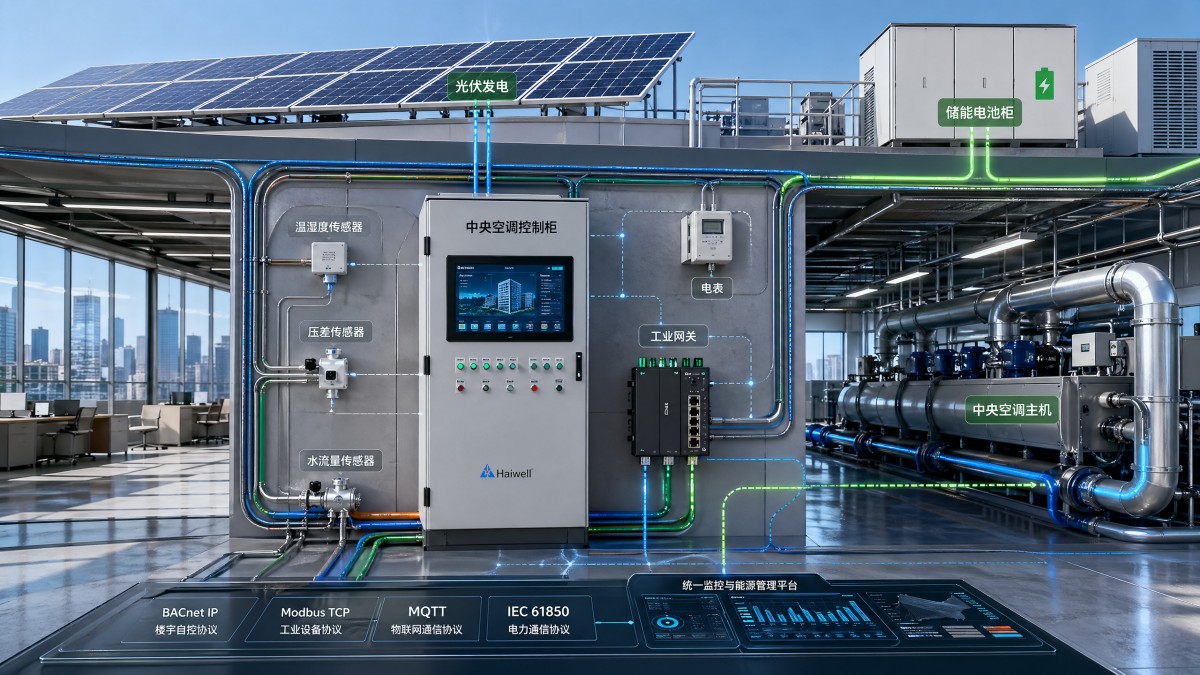
In energy-conscious commercial buildings, HVAC commonly represents 35% to 55% of total electricity use, depending on climate zone, occupancy density, and ventilation requirements. That makes the controller one of the most important decision points in any renewable energy strategy. A poorly integrated HVAC automation controller can erase gains from solar PV, heat pumps, smart relays, and energy monitoring systems.
The issue becomes even more critical in buildings using peak-load shifting. If a controller cannot react within a practical latency window—often under 500 milliseconds for certain control events and under 2 seconds for broader orchestration—it may fail to align cooling loads with solar overproduction or battery discharge schedules. Renewable energy value is created not only by generation, but by timing and control accuracy.
For operators, integration quality affects daily usability. When alarms arrive late, sensor values drift, or mesh nodes drop under interference, maintenance teams lose trust in the platform. Instead of proactive optimization, they revert to manual overrides. That often leads to longer compressor runtime, unstable zone balancing, and avoidable comfort complaints.
For procurement leaders, the challenge is that many product claims stop at protocol logos. “Matter-ready” or “supports Zigbee mesh” says little about node density, packet loss, standby power, or PID tuning stability under real conditions. In renewable energy projects, procurement errors can remain hidden for 6 to 18 months, only appearing after commissioning when occupancy and seasonal demand rise.
The Controller as an Energy Orchestration Layer
A modern controller should not be viewed as a thermostat upgrade. It is an orchestration layer linking sensors, dampers, relays, VAV boxes, heat pumps, inverters, submeters, and cloud or edge analytics. In renewable energy environments, its job includes balancing comfort targets with load flexibility, local generation patterns, and grid participation requirements.
The following table outlines why controller performance affects far more than room temperature.
The key takeaway is straightforward: controller selection affects renewable energy economics, operational stability, and long-term service burden. This is why benchmarking under realistic building conditions matters more than surface-level compatibility claims.
Understanding the Integration Trap: Protocols, Latency, and Real-World Failure Points
The integration trap occurs when a controller appears interoperable in a lab or sales demo, but fails in a real building ecosystem. This usually happens at the boundary between protocol support and protocol performance. A device may join a Thread network, pair with Matter, or relay Zigbee traffic, yet still perform poorly when network hops increase, interference rises, or command volumes spike during peak HVAC cycles.
In renewable energy facilities and green commercial buildings, HVAC traffic is not static. Data flows increase during occupancy transitions, weather changes, and energy price events. At 8:00 a.m., 1:00 p.m., and 5:30 p.m., command density can jump sharply as zones rebalance, ventilation ramps up, and storage strategies shift. Controllers that seem stable at 20 nodes may become unreliable at 120 nodes.
Latency is one of the most overlooked variables. For example, a single command delay of 200 to 400 milliseconds may be acceptable for status display, but repeated delays across multi-node hops can accumulate into operational lag. In a PID-controlled HVAC environment, inconsistent response intervals can degrade control smoothness, leading to overshoot, undershoot, and inefficient compressor or fan behavior.
Another common failure point is mixed-protocol coexistence. Buildings often combine legacy BACnet or Modbus assets with newer Zigbee, BLE, Thread, or Wi-Fi modules. The weak point is not any one protocol by itself; it is the gateway logic, buffering strategy, and event handling under simultaneous traffic. Without robust translation and queue management, dropped packets and stale telemetry become recurring problems.
Four Signs a Project Is Headed into the Trap
- Controller specifications mention protocol support, but do not disclose tested node count, hop depth, or command latency under load.
- Battery-powered sensors are added without discussing polling intervals, sleep behavior, or battery discharge under dense reporting schedules.
- Gateway architecture depends on a single bridge for multiple floors, creating congestion during simultaneous HVAC events.
- Commissioning focuses on pairing success rather than 7-day or 30-day stability under occupancy and weather variability.
What Buyers Should Ask Before Procurement
Before final selection, buyers should request benchmark evidence on at least 6 practical points: node capacity, average latency, worst-case latency, packet retry behavior, standby power, and behavior under interference. These metrics are especially relevant where HVAC controllers interact with solar inverters, energy storage, and submetering systems.
The table below provides a procurement-oriented framework for assessing integration risk in climate control hardware.
A buyer who asks these questions early can avoid expensive retrofit work later. In many commercial projects, integration defects cost far more to correct after occupancy than during specification review.
How to Evaluate HVAC Controllers with Data, Not Marketing Language
NexusHome Intelligence approaches HVAC automation controllers as measurable engineering systems rather than branding claims. In renewable energy deployments, this perspective is essential because every failure in control logic can ripple into higher energy use, lower self-consumption, and more manual maintenance. The goal is to translate controller quality into verifiable operating behavior.
A useful evaluation framework starts with five measurable layers: protocol reliability, control stability, power behavior, interoperability with energy systems, and maintainability. Instead of asking whether the controller is “smart,” ask how it behaves after 10,000 command cycles, during noisy RF conditions, or when multiple zone calls occur at the same time.
For renewable energy buildings, PID behavior deserves special attention. A controller with unstable tuning may cause temperature oscillation of 1.5°C to 3°C across heavily occupied zones. That can trigger unnecessary reheating, excess fan use, or repeated compressor starts. Those inefficiencies directly undermine decarbonization targets.
The testing process should also separate idle efficiency from active performance. Some devices perform well when idle but draw excessive standby power or exhibit battery degradation under frequent telemetry reporting. In projects with dozens or hundreds of edge devices, even small per-device inefficiencies accumulate over a 12-month operating cycle.
A Practical 5-Step Benchmarking Sequence
- Verify protocol compliance and onboarding repeatability across at least 20 consecutive pairing cycles.
- Measure command latency at baseline and under load, including multi-hop scenarios and interference conditions.
- Stress test control outputs with changing occupancy, weather input, and energy scheduling events over 24 to 72 hours.
- Record standby and active power behavior, especially for relays, sensors, and battery-assisted nodes.
- Audit recovery logic after gateway reboot, packet loss, or cloud uplink interruption.
Decision Metrics That Matter Most
Procurement and engineering teams often need a concise way to compare options. The table below focuses on metrics that help distinguish a controller suited for renewable energy buildings from one that merely appears feature-rich.
This kind of evidence-based evaluation is especially valuable when comparing OEM or ODM options from multiple manufacturing sources. It transforms sourcing from a price-driven exercise into an engineering decision with measurable downstream impact.
Implementation Guidance for Operators, Procurement Teams, and Decision-Makers
Selecting the right HVAC automation controller is only half the job. The other half is deploying it in a way that protects renewable energy performance over the long term. In practice, many integration failures come from compressed commissioning schedules, incomplete device mapping, or underdefined handoff between procurement and operations teams.
A good implementation plan usually spans 3 stages: specification review, pilot validation, and full-scale rollout. For medium commercial projects, a pilot may cover 1 floor, 10 to 30 zones, or a representative area with mixed occupancy. This creates a manageable test environment for validating latency, zone stability, and gateway behavior before large-scale commitment.
Operators should also define acceptance criteria before installation starts. For example, they may require stable response during morning warm-up, clean alarm handling for sensor faults, and predictable recovery after power cycling. Without pre-agreed thresholds, post-install disputes often become subjective and slow to resolve.
Decision-makers should view support capability as part of technical fit. If firmware updates, diagnostics, or replacement workflows are unclear, operational risk rises. In renewable energy projects, where HVAC increasingly interacts with energy management systems, unclear support pathways can delay corrective action during critical demand periods.
Recommended Deployment Checklist
- Map every protocol boundary, including gateways, bridges, and legacy interfaces such as BACnet or Modbus.
- Define target response times for alarms, zone changes, and energy scheduling events.
- Run a pilot for at least 2 to 4 weeks to capture occupancy variation and weather shifts.
- Measure battery impact where wireless sensors report at high frequency.
- Document rollback procedures for firmware updates and network reconfiguration.
Common Mistakes to Avoid
Three mistakes appear repeatedly. First, teams buy for protocol label rather than measured performance. Second, they validate only normal operation, not failure recovery. Third, they assume all buildings have similar RF and thermal behavior. In reality, building materials, floor geometry, and occupancy patterns can alter controller performance dramatically.
For enterprise buyers and developers, the smarter path is to require benchmark-backed sourcing and staged acceptance. This is where NHI’s role as an independent engineering filter becomes especially relevant: translating supplier claims into usable procurement intelligence for real buildings and real renewable energy operating conditions.
FAQ: Selecting HVAC Automation Controllers Without Falling into the Integration Trap
How do I know whether a controller is suitable for a renewable energy building?
Look beyond protocol support. You need evidence that the controller can coordinate with energy monitoring, solar generation logic, storage schedules, and occupancy-based HVAC control. Ask for latency data, node capacity tests, standby power measurements, and recovery behavior after outage scenarios. These indicators are more useful than generic compatibility statements.
Is Matter enough to guarantee interoperability?
No. Matter can improve device onboarding and interoperability expectations, but it does not automatically guarantee stable performance in every commercial building. Real results still depend on gateway design, Thread network quality, command volume, and interaction with older building systems. In projects with 50 or more active endpoints, these practical factors become decisive.
What is a realistic pilot period before full deployment?
A practical pilot often runs 2 to 4 weeks. That is usually enough to capture weekday and weekend patterns, morning start-up behavior, weather-related load changes, and at least several maintenance observations. For more complex sites with storage integration or mixed tenancy, longer pilot windows may be justified.
Which teams should be involved in controller selection?
The best decisions usually involve at least four groups: procurement, building operations, controls engineering, and energy or sustainability leadership. Procurement evaluates supply risk and supportability. Operators assess maintainability. Engineers validate integration behavior. Sustainability or energy teams ensure the controller supports decarbonization and peak-load strategies.
The integration trap is rarely caused by one bad feature. More often, it is the result of incomplete verification across protocols, latency, control behavior, and support workflows. For renewable energy buildings, that gap can translate into lower solar utilization, unstable HVAC performance, and higher operating cost over time.
NexusHome Intelligence exists to close that gap with benchmarking discipline, protocol transparency, and engineering-first analysis. If you are comparing HVAC automation controllers, planning a smart building retrofit, or sourcing IoT climate control hardware for renewable energy applications, now is the time to move from claims to evidence.
Contact NHI to discuss benchmarking priorities, request a tailored evaluation framework, or explore data-driven sourcing support for your next smart building or clean energy integration project.
Protocol_Architect
Dr. Thorne is a leading architect in IoT mesh protocols with 15+ years at NexusHome Intelligence. His research specializes in high-availability systems and sub-GHz propagation modeling.
Related Recommendations
- Kenji Sato (Infrastructure Arch)What Makes a Smart Thermostat OEM Worth Comparing
- Kenji Sato (Infrastructure Arch)HVAC Automation Controllers and the Integration Trap
- Kenji Sato (Infrastructure Arch)VDE Tightens Standby Power Limit for Matter-over-Thread Gateways to ≤0.2W
- Kenji Sato (Infrastructure Arch)VDE Tightens Matter-over-Thread Gateway Standby Power to ≤0.2W
- Kenji Sato (Infrastructure Arch)ISO/TR 37115-1:2026 Zero-Carbon City Standard Released
- Kenji Sato (Infrastructure Arch)VDE Enforces Stricter Energy Efficiency for Matter-over-Thread Gateways
- Kenji Sato (Infrastructure Arch)HVAC automation controllers now compete on data quality too
- Kenji Sato (Infrastructure Arch)What to compare before shortlisting a smart thermostat OEM
- Kenji Sato (Infrastructure Arch)Climate control hardware benchmarking should not stop at COP
- Kenji Sato (Infrastructure Arch)VDE Releases Matter-over-Thread Gateway Efficiency Standard
Analyst